GizmoData Cloud
Hardcharger and DuckLake, fully managed on AWS, Google Cloud and Azure.
Launch Hardcharger, GizmoData’s DuckDB 2.0 server over Chargewire, in minutes. Connect your existing tools, keep data in open lakehouse storage, and pay by the hour for what you run. Existing GizmoSQL clusters are managed from the same console.

Start free with $25 of launch credit, applied automatically. No credit card needed — details below.


Automatic resume
Let compute rest. Connect to wake it.
Available on eligible Hardcharger clusters. The first connection waits for startup.
- Plans from $29/month, and the monthly fee comes back in full as compute credit
- See the Hardcharger benchmarks with measured results, methods and caveats
- Runs in AWS, Google Cloud or Azure, or in your own cloud account
New: the starter kit
Sign up and just begin
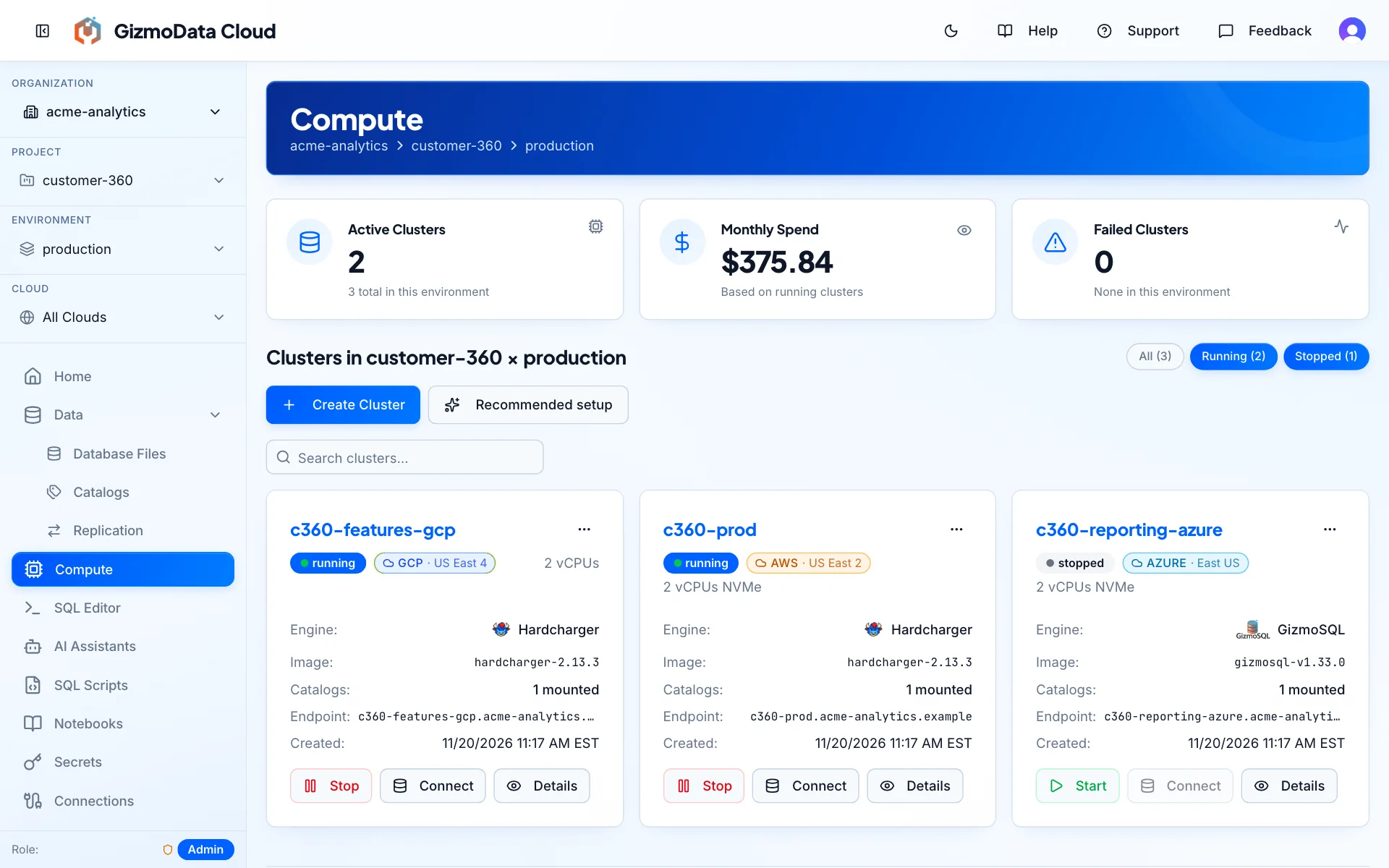
Keep Set up my starter kit ticked when you create your organization, and GizmoData Cloud builds a complete place to work: your data lake, the catalogs that record what your cluster does, and a Hardcharger cluster with its own load balancer. All that’s left is to click Connect.
Ready in moments, or about 10 minutes. GizmoData keeps organizations built ahead of time in some regions: pick one of those for your first organization and it is yours, ready to go. Elsewhere the kit is set up right after your first project, and you can watch each step tick off.
Start at 2 vCPUs, resize any time. When you need more power, pick a bigger size with Edit Configuration on the cluster’s page. A running cluster restarts briefly on the new machine (queries running at that moment are interrupted) and keeps its address; change it while the cluster is stopped and it simply takes effect on the next start. Sizes go up to what your plan’s vCPU quota allows.
No surprises. Before you start, the form shows what the kit’s cluster costs per hour, running and stopped. Every piece is an ordinary catalog or cluster you can rename, change, stop or delete.
Already signed up? Recommended setup, next to Create Cluster on the Compute page, makes the same kit in any project and environment, without touching what you already have.
With the $25 launch credit, the kit’s cluster starts on the credit right away. No credit card needed.
English narration and captions. Portal scenes are demo captures of a fictional organization; provisioning times are illustrative.
Your data lake (DuckLake)
An encrypted DuckLake catalog for your own tables, on storage GizmoData provisions in the same region.
Instrumentation catalog
A PostgreSQL catalog where the cluster records its sessions, the statements run and their timings.
Access-control (RBAC) store
The cluster’s users, roles and grants, in a PostgreSQL catalog other Hardcharger clusters can share.
Logging catalog
A DuckLake catalog the cluster writes its logs to.
Your Hardcharger cluster
It starts at two vCPUs, and you can resize it whenever you need more. Managed credentials and Sign in with GizmoData Cloud for its web UI. It stops after 15 minutes without queries and starts again when you connect.
A dedicated load balancer
The cluster’s own address, answering by the time the kit finishes, so Connect works right away.


The cluster also mounts GizmoData’s public catalogs in the same cloud and region, read-only, such as the TPC-H and TPC-DS benchmark datasets.
Talk to your data
Ask your data. Act with confidence.
Ask questions in everyday language with Claude and GizmoData Cloud MCP. Your identity follows every request to Hardcharger, where role-based access control governs what you can read and change.
English narration and captions. Illustrative Claude conversations with fictional data.
New in GizmoData Cloud
Schedule pipelines, work in notebooks and connect what you already have
Your Hardcharger clusters now come with the tools around them: scheduled jobs, built-in replication, JupyterLab notebooks and saved connections. Every run shows what its code steps cost.
Schedule your pipelines
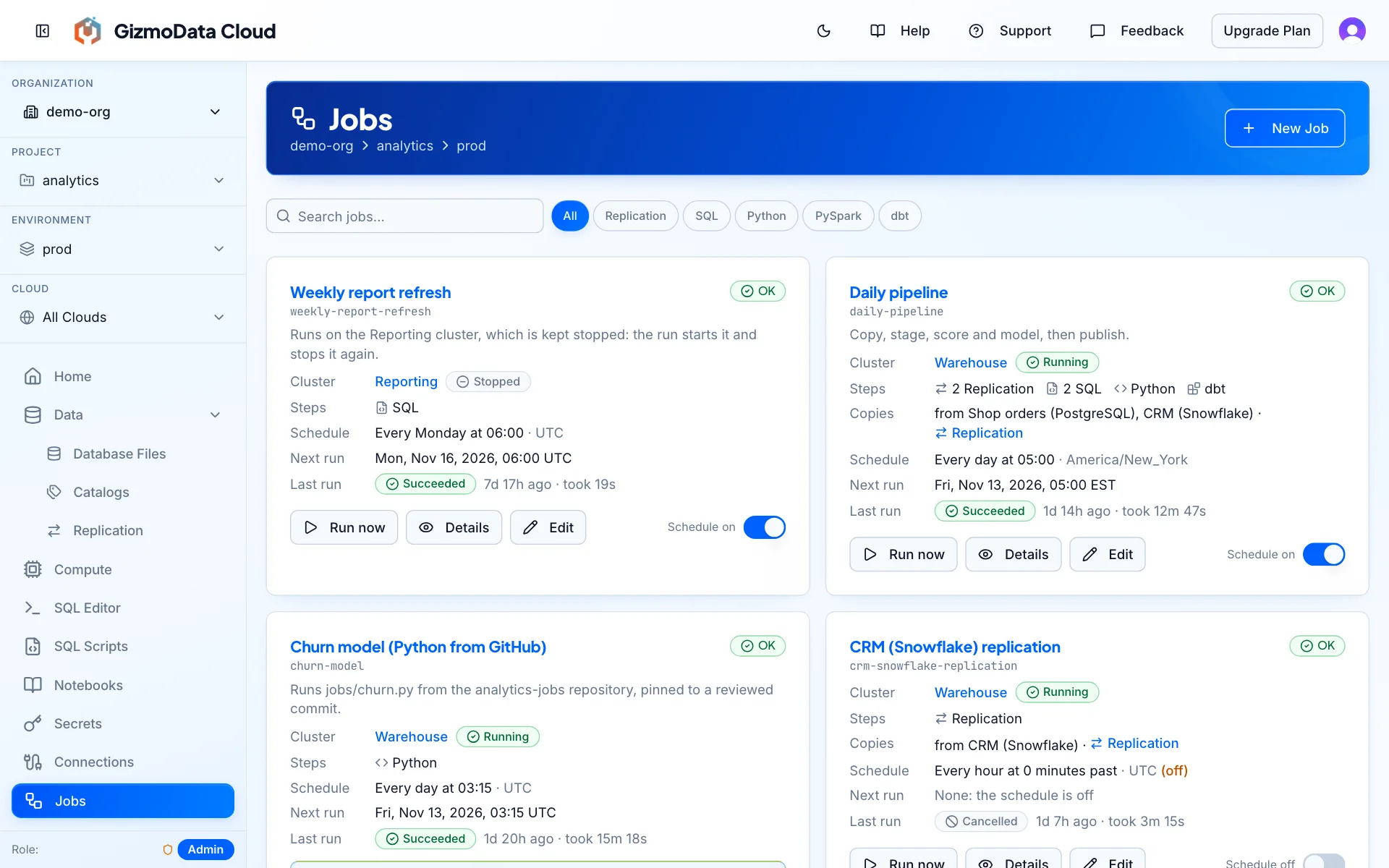
Jobs run Replication, SQL, Python, PySpark and dbt steps on a Hardcharger cluster, in the order you draw, on a schedule or on demand.
See howKeep data in sync
Copy tables and views into Hardcharger from PostgreSQL, Oracle Database, Snowflake or another Hardcharger server, and keep the copy up to date.
See howWork in notebooks next to your data
Open JupyterLab next to your cluster, already signed in, with Python and PySpark kernels, %%sql cells, Git and files that stay between sessions.
See howConnect what you already have
Save a connection once, mount it on Hardcharger clusters and query it with SQL. Read your S3 buckets through an AWS role, with no keys stored.
See howSee what it costs
Each run shows what its Python, PySpark and dbt steps came to, each job its last 30 days, and Organization > Usage a line for each job and notebook session.
See howPython, PySpark and dbt steps and notebooks run where a data plane offers them: today that is AWS US East 2 (Ohio). Jobs with Replication and SQL steps, connections and everything else here work on AWS, Google Cloud and Azure.
Read the announcementSchedule your pipelines on a Hardcharger cluster
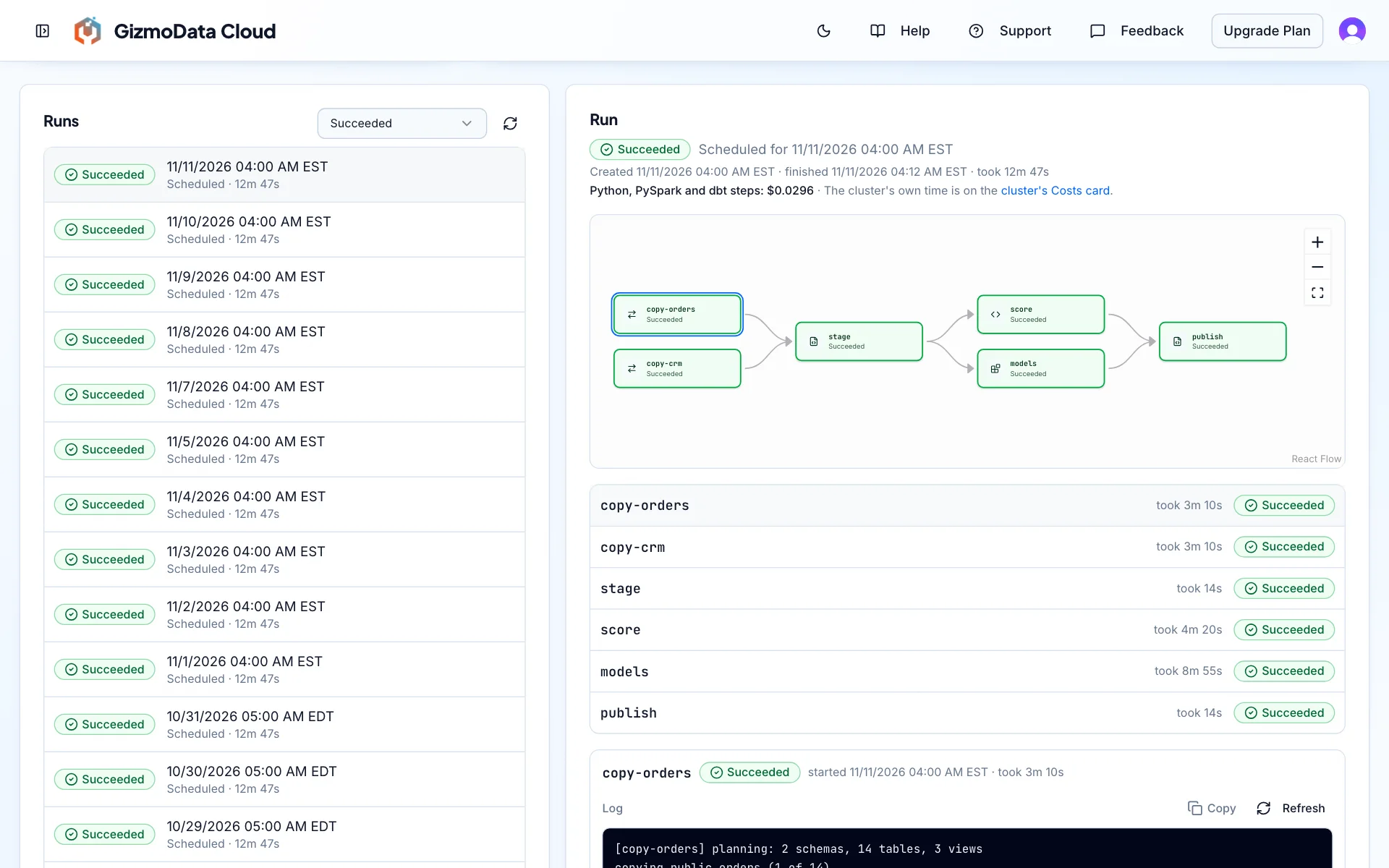
A job is a set of steps you draw as a graph: each step starts once the steps before it have succeeded, and steps that wait for nothing run side by side. Run it on a schedule, in the time zone you choose, or whenever you like with Run now.
- Five kinds of step: Replication, SQL, Python, PySpark and dbt
- Python and PySpark steps run your own code, typed in or fetched from a GitHub repository, with a connection to the cluster already signed in: no password goes in the code. pandas, polars and pyarrow are installed
- dbt steps run a dbt Core project from a GitHub repository. The platform writes the connection profile for you, and each run shows how many models and tests passed and names any that did not
- Run history, live logs while a step runs, and a Slack message when a job starts failing and when it works again
- A run starts a cluster that stopped for being idle. With Start the cluster if it is stopped switched on, it also starts a cluster a person stopped, and stops it again when the run ends
- Every step signs in as the job’s own user, with the role you give it: Admin, User or Read-only
Jobs run on Hardcharger clusters. Replication and SQL steps run on AWS, Google Cloud and Azure. Python, PySpark and dbt steps run where a data plane offers them: today that is AWS US East 2 (Ohio).
Engineering walkthrough
English narration and captions. Product captures and illustrative animations.

Keep data in sync with replication into Hardcharger
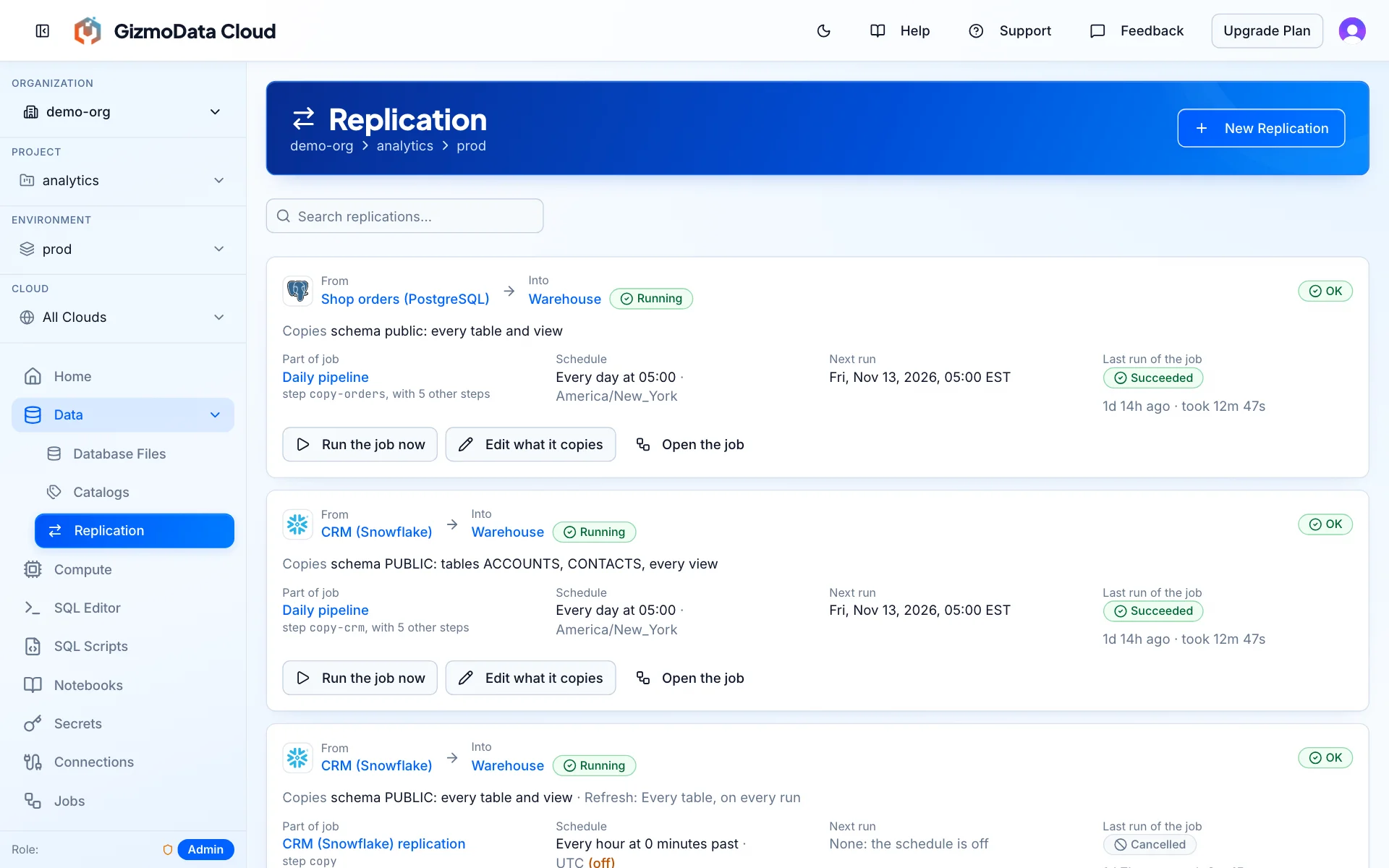
Copy tables and views from PostgreSQL, Oracle Database, Snowflake or another Hardcharger server into a Hardcharger cluster, and keep the copy up to date on a schedule. Data > Replication lists every replication with its source, its cluster, its schedule and how its last run went.
- Choose schemas, tables and views by pattern. Plan shows what a run would copy before anything is copied
- Leave columns out, or mask them with a SHA-256 hash or an empty value. Masks run in the source database, so the real values never leave it
- Views are recreated on the cluster, with their SQL translated for it
- Copy only the tables that changed, every table on every run, or only the changed rows of tables that have a key
- Start one from a saved connection with Set up replication. Each replication is a step of a job, so SQL or dbt steps can run after the copy
Engineering walkthrough
English narration and captions. Product captures and illustrative animations.
Work in notebooks next to your data
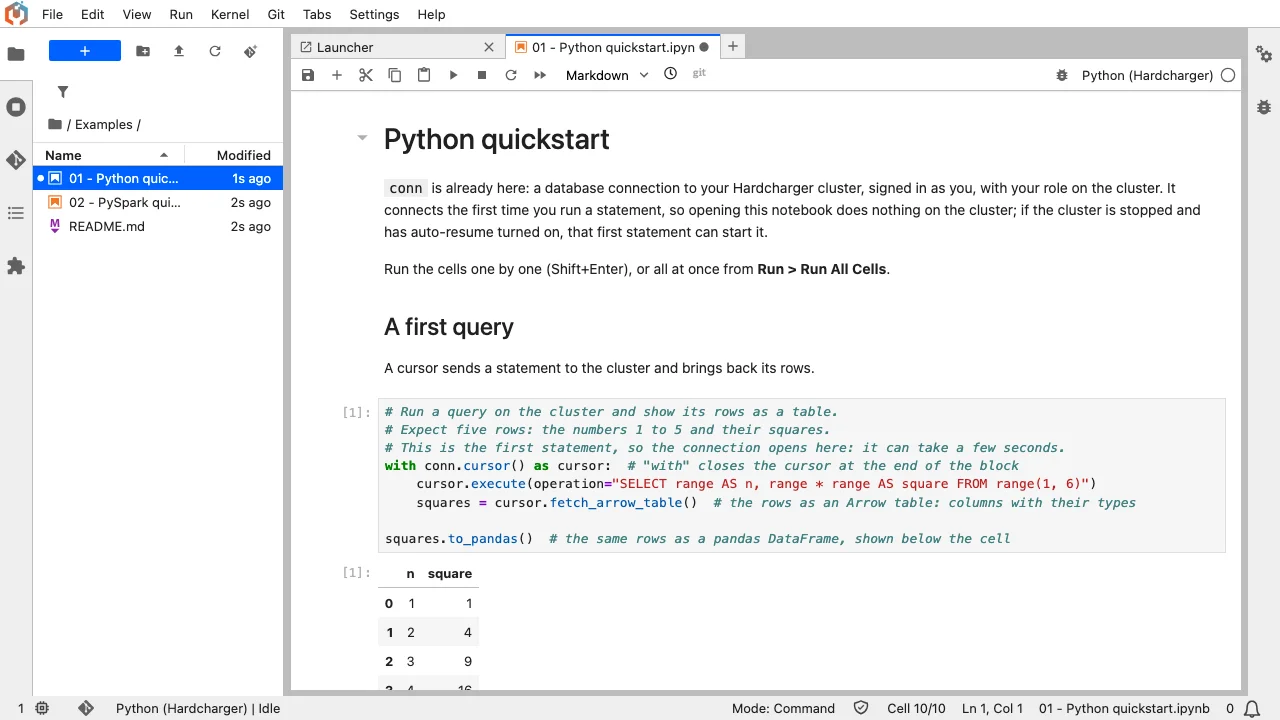
Start a JupyterLab session next to a Hardcharger cluster. It opens in a new tab, already signed in to the cluster as you, with your own access to it. Your files live in a workspace on that cluster, kept from one session to the next.
- Python and PySpark kernels: PySpark DataFrame operations run on the cluster itself, with no Spark cluster to start
- A %%sql cell runs SQL on the cluster and gives you the result as a DataFrame
- Starter notebooks in an Examples folder: a Python starter with a quick query, a %%sql cell and a small ADBC ingest, and a PySpark starter with a DataFrame query
- Git in JupyterLab, with your name and email, and a GitHub token secret for private repositories
- Notebooks, data and the Python packages you install stay in your workspace for your next session
- JupyterLab in GizmoData Cloud’s colours and logo, so a notebook tab is easy to tell apart
Notebooks run next to Hardcharger clusters where a data plane offers them: today that is AWS US East 2 (Ohio). A session ends on its own after a stretch with nothing going on, and your files stay.
Engineering walkthrough
English narration and captions. Product captures and illustrative animations.

Connect what you already have
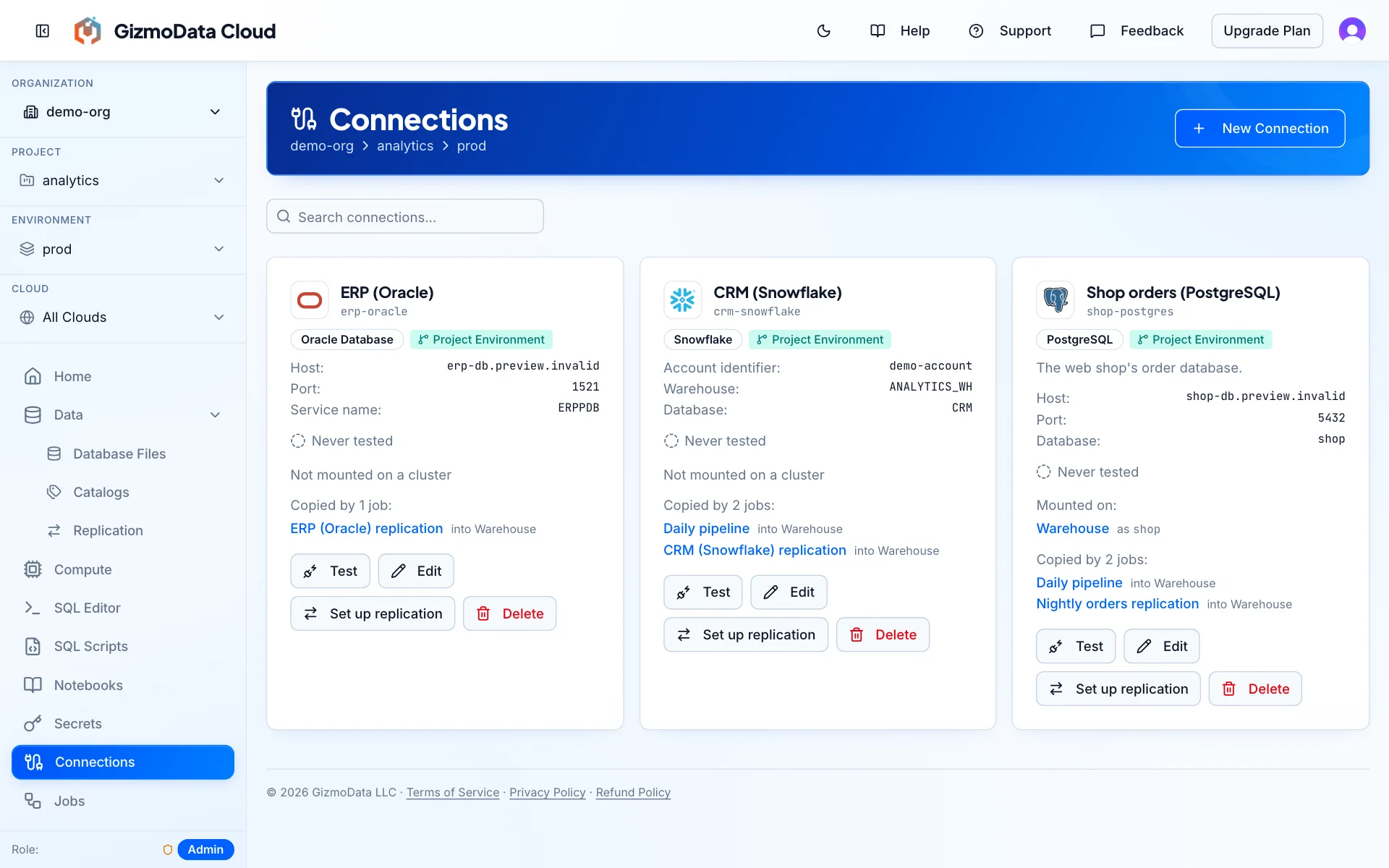
Save a connection to PostgreSQL, Snowflake, Oracle Database, IBM Db2, Quack, Hardcharger or GizmoSQL once, and test it from your data plane. Then mount it on Hardcharger clusters and query its tables with SQL, next to your own data.
- A form made for each system, with the sign-in methods it offers
- Mount a connection on a cluster under a SQL name, then select from its tables by schema and name, or let the source run a whole query and return only the result
- The same connection can be the source of a replication: Set up replication starts one from its card, and Copied by lists the jobs that copy from it
- S3 access without keys: an AWS role secret lets a Hardcharger cluster read your S3 buckets through an IAM role in your own AWS account. No access key is stored, and short-lived credentials renew automatically
Engineering walkthrough
English narration and captions. Product captures and illustrative animations.
See what every run costs
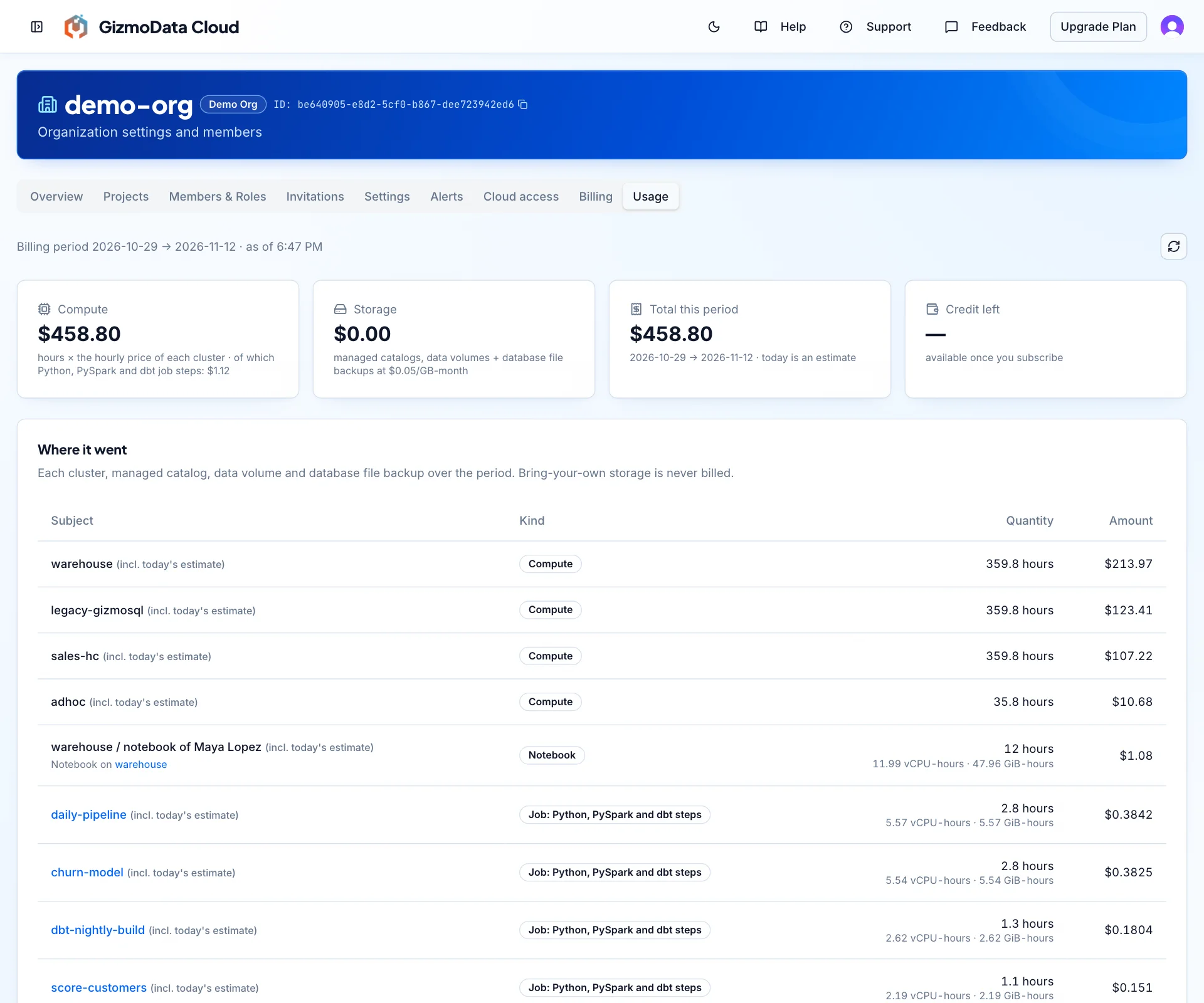
Python, PySpark and dbt steps and notebook sessions are billed for the time they run, by the second, at $0.062 per vCPU-hour plus $0.007 per GiB-hour of the size you choose. Replication and SQL steps have no charge of their own: the cluster’s running time is billed as before.
- Before you start: a step’s form and the notebook dialog show the price of the size you pick
- A run’s page shows what each Python, PySpark and dbt step used and what it came to
- A job’s page shows its last 30 days, day by day
- Organization > Usage has a line for each job with Python, PySpark or dbt steps and for each notebook session, next to your clusters
Automatic resume
Stop paying for idle compute. Connect to start again.
Pair Stop when idle with Auto-resume: your Hardcharger cluster stops between periods of use, then starts when a client connects with valid credentials. The hostname stays the same, and nobody needs to press Start.
1. Stop when idle
Choose an idle window. When no SQL is running or starting during that window, the cluster stops and compute charges stop.
2. Check the connection
A client connects to the same address. Credentials are checked before compute starts; invalid credentials leave it stopped.
3. Resume and get to work
Supported drivers and the hosted MCP connector wait for the cluster to become ready, then connect. After the next idle window, it can stop again.
Plan for the first connection
A resume takes about 30 seconds on shared compute and a few minutes on dedicated compute; capacity, startup scripts and data loading affect the wait. The web UI and portal SQL editor still need you to press Start.
Keep the savings clear
Compute billing resumes when the cluster is running. A dedicated load balancer kept for auto-resume is still billed while stopped. The shared gateway adds no endpoint charge; managed storage is billed separately.
Auto-resume is opt-in: Hardcharger, managed authentication, one fixed replica and autoscaling off. An access-control store requires Hardcharger 2.6.0 or later. Enable it in the create wizard or Edit Configuration, then start the cluster once.
Driver support and automatic resume FAQAsk Claude about your data. It signs in as you.
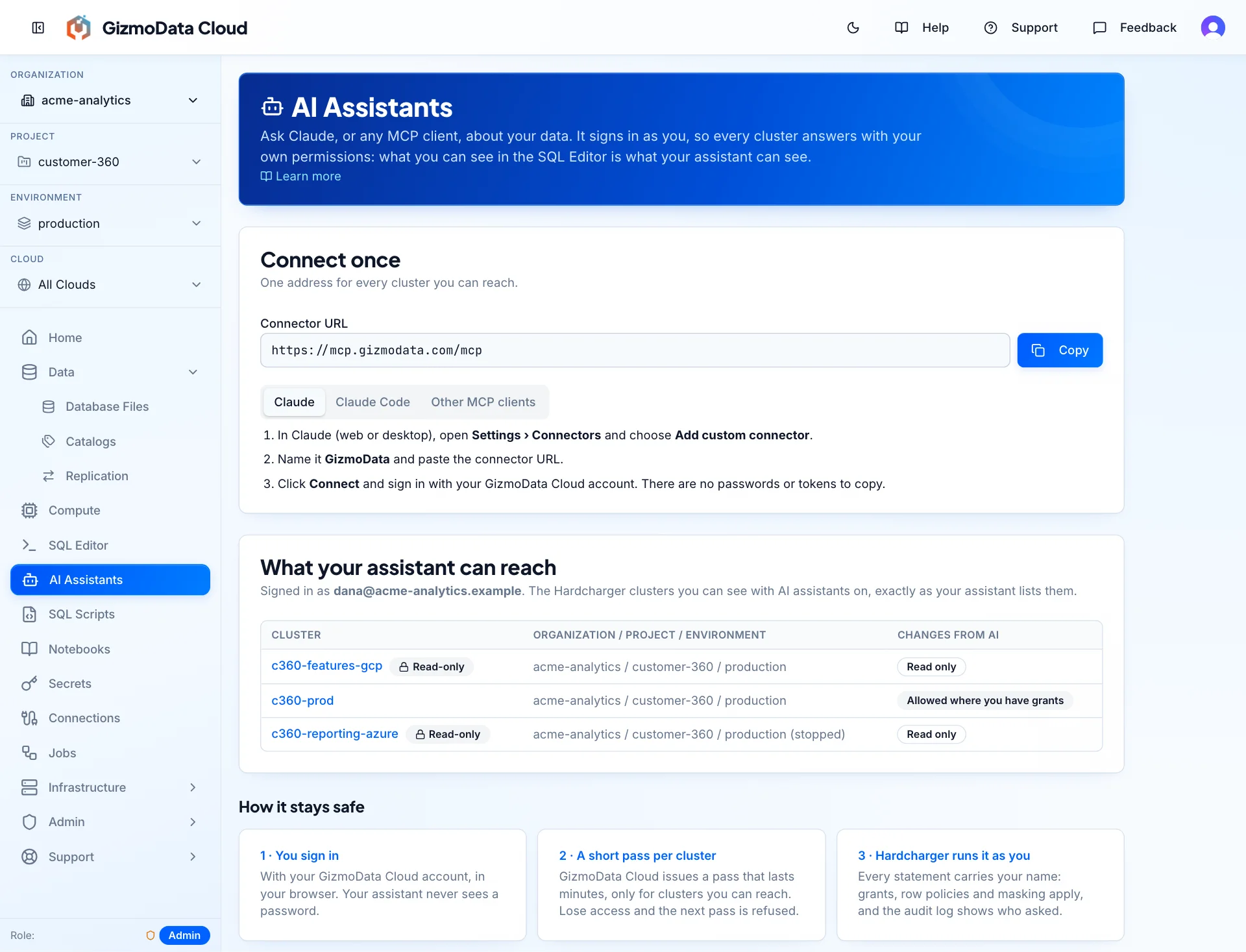
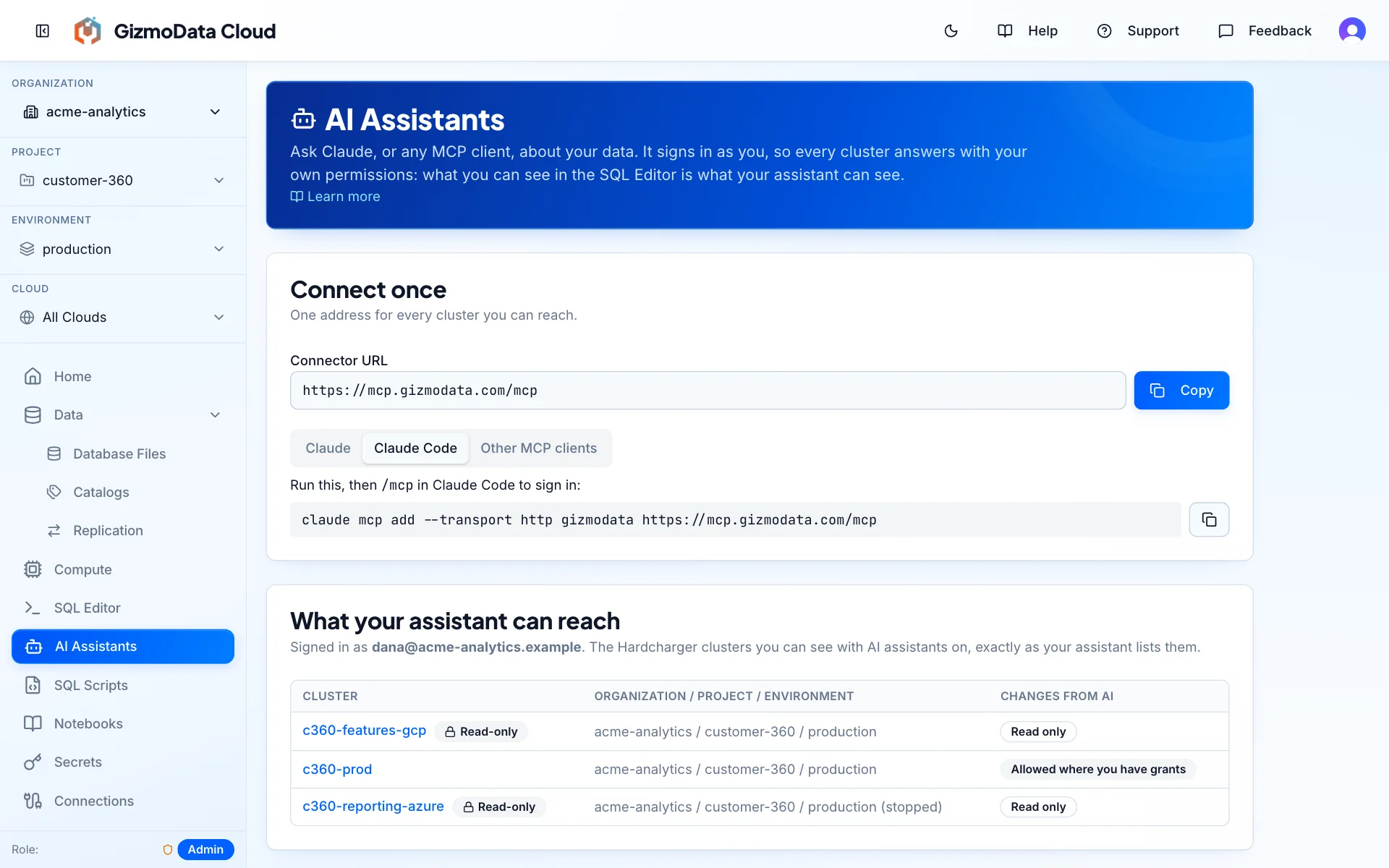
Add one connector URL to Claude, Claude Code or any other MCP client and sign in with your GizmoData Cloud account. There are no passwords or tokens to copy. From then on, every statement your assistant runs, runs as you: Hardcharger applies your grants, row policies and masking, and its audit log shows who asked. What you can see in the SQL Editor is what your assistant can see, and nothing more.
- One connector, https://mcp.gizmodata.com/mcp, for every Hardcharger cluster you can reach, across organizations, projects and clouds
- OAuth sign-in in your browser: your assistant never sees a password, and it gets a pass that lasts minutes, only for the clusters you can reach
- Lose access to a cluster in GizmoData Cloud and your assistant loses it too, within about a minute
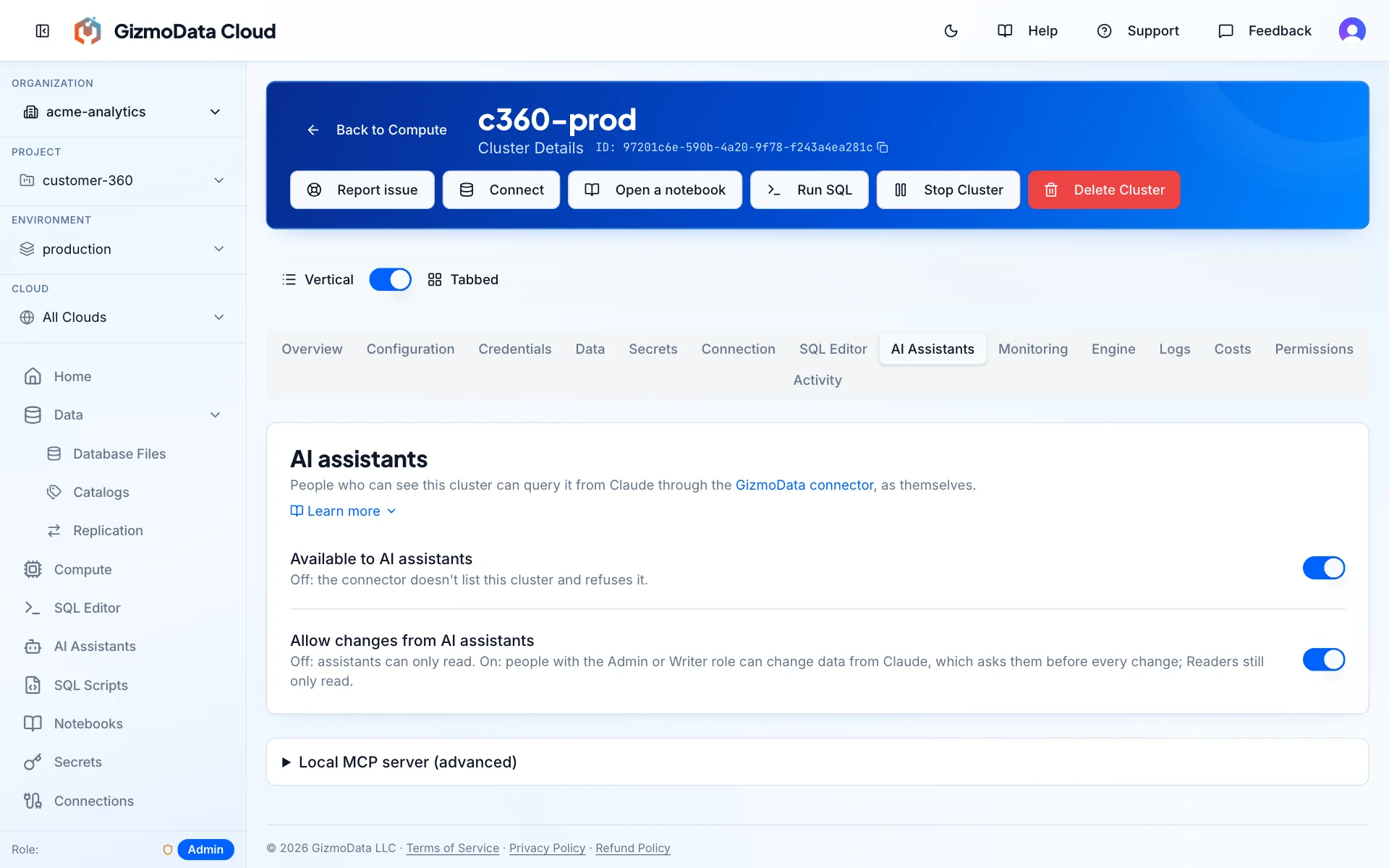
- Changes only where you may make them: with access control, Hardcharger’s grants decide; without it, assistants only read unless a cluster admin allows changes, and then only for the Admin and Writer roles
- Cluster admins choose which clusters are available to AI assistants, and Claude asks you before it runs anything that changes data
The connector serves Hardcharger clusters. For tools that can’t sign in through a browser, and for existing GizmoSQL clusters, a cluster can still issue a token for a local MCP server.
The latest compute for your data workload
DuckDB runs each query on a single node, so every new processor generation is a straight speed-up for your queries. GizmoData Cloud runs on the newest Arm chips each cloud offers — including AWS Graviton 5 — in memory-optimized shapes with local NVMe SSD, and adds new generations as they ship.
Graviton 5
AWS · r9gd
AWS’s newest Arm processor, generally available since August 2026. It ran the full TPC-H 1 TB benchmark in 80 seconds on a single r9gd.24xlarge — 10% faster than Graviton 4.
Graviton 4
AWS · r8gd
The previous flagship Graviton: memory-optimized, with local NVMe SSD. Choose it or Graviton 5 per cluster.
Axion
Google Cloud · C4A
Google’s custom Arm processor. C4A shapes from 4 vCPUs up carry local SSD for DuckDB’s spill and scratch space; 1–2 vCPU shapes cover light workloads.
Cobalt 100
Microsoft Azure · Epdsv6
Microsoft’s custom Arm processor, in the memory-optimized Epdsv6 shapes with local NVMe.
Pick the generation and size per cluster; the hourly price is shown before you create it, and a newer generation simply costs what its machines cost.
See the TPC-H 1 TB benchmark: Graviton 5 vs. Graviton 4 vs. Cobalt 100The data plane goes where your data is. The control plane stays in one place.
Most “multi-cloud” platforms mean one deployment per cloud, each with its own console. GizmoData Cloud runs a single control plane that manages Kubernetes data planes in AWS, Google Cloud and Azure at the same time — so a project can have its EU clusters in Ireland, its ML feature store next to GCS in Oregon, and its finance reporting on Azure, and you administer all of it from one organization with one set of roles.
Amazon Web Services
AWS
EKS data planes on Graviton 5 (r9gd) and Graviton 4 (r8gd) NVMe shapes, S3-backed DuckLake, NLB-terminated TLS.
Google Cloud
GCP
GKE data planes on Axion (C4A) local-SSD shapes, GCS-backed DuckLake, per-cloud tuning profiles.
Microsoft Azure
Azure
AKS data planes on Cobalt (Epdsv6) NVMe shapes, Azure Blob / ADLS-backed DuckLake, and Azure Marketplace billing on the roadmap.
Region-aware placement
Catalogs, secrets and firewall rules can all be qualified by cloud and region. When a cluster is created, defaults resolve to the nearest matching region up the scope chain — exact region first, then cloud-wide, then neutral.
Egress governance, built in
Turn on cross-region mount governance and the platform refuses to attach a catalog whose data lives in a different region from the compute — the exact error tells you which region each side is in. No surprise inter-region bills.
Shapes that match the cloud
Instance sizes are cloud-specific (Graviton 5 r9gd and Graviton 4 r8gd on AWS, Axion C4A on GCP, Cobalt 100 Epdsv6 on Azure) and validated against the cloud you picked, so you cannot accidentally ask AWS for an Azure shape.
Where GizmoData Cloud runs today
Self-serve organizations can launch clusters in these regions right now.
- AWSUS East (Ohio)
us-east-2 - Google CloudUS East (Northern Virginia)
us-east4 - Microsoft AzureEast US 2 (Virginia)
eastus2
Provision Hardcharger clusters in any cloud, from one screen
Run Hardcharger, GizmoData’s DuckDB 2.0 server over Chargewire, on managed Kubernetes in the cloud and region you choose. Pick an instance shape, mount your catalogs and secrets, and serve queries in minutes. Existing GizmoSQL clusters remain available alongside it, with their Arrow Flight SQL clients.
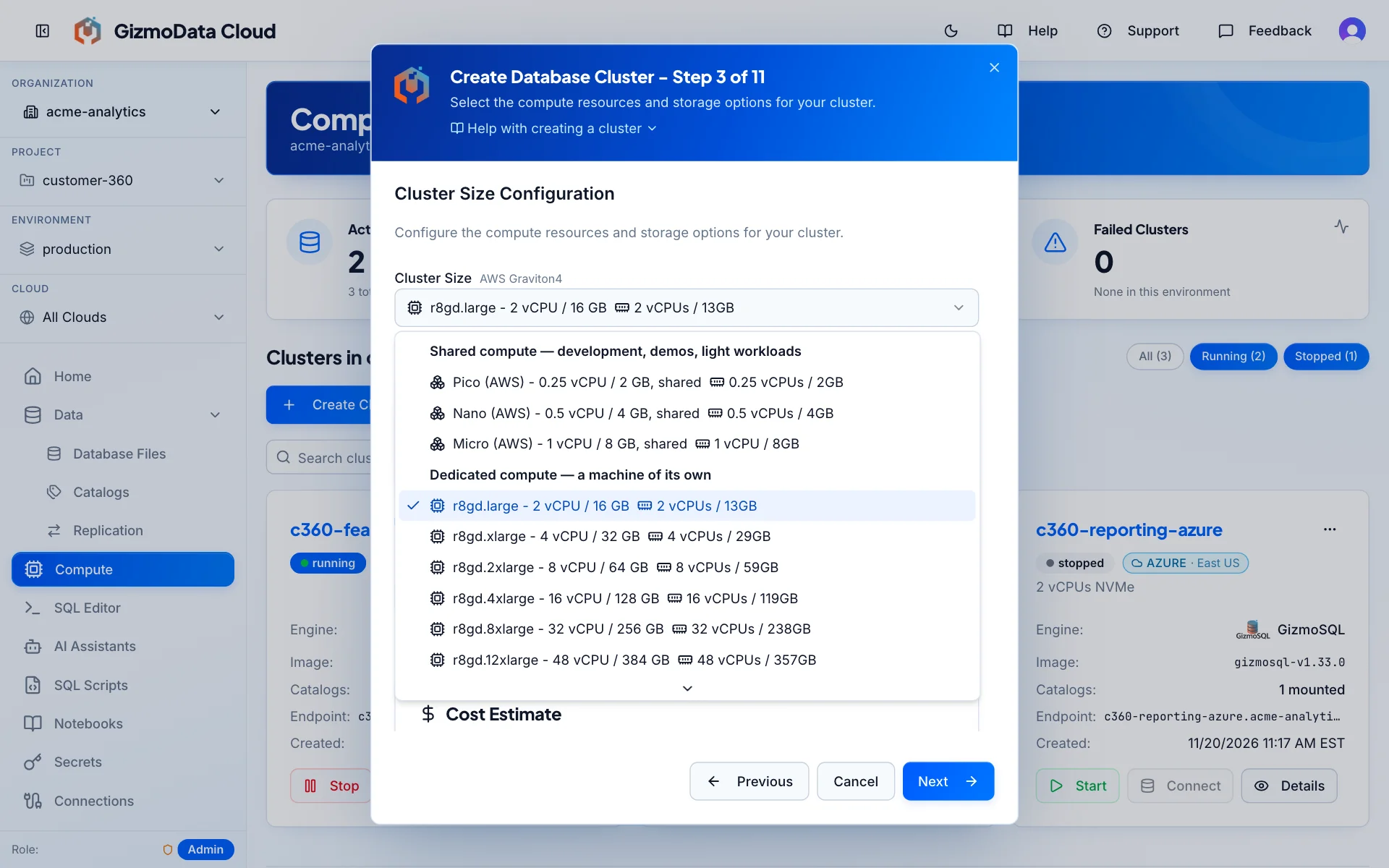
- Instance shapes per cloud: AWS Graviton 5 (r9gd) and Graviton 4 (r8gd), Google Axion (C4A), Azure Cobalt 100 (Epdsv6) — picked from a live, priced menu
- Shared compute for development, demos and light workloads — Pico (0.25 vCPU / 2 GB), Nano (0.5 vCPU / 4 GB) and Micro (1 vCPU / 8 GB), from $0.028/hour — next to dedicated machines for production
- Autoscaling (min/max replicas, CPU & memory targets) plus calendar-based autoscaling schedules
- Every Hardcharger server feature included, with no edition fee: instrumentation, query logs, metrics and access control
- Stop when idle and automatically resume eligible Hardcharger clusters on a connection with valid credentials
Engineering walkthrough
English narration and captions. Product captures and illustrative animations.
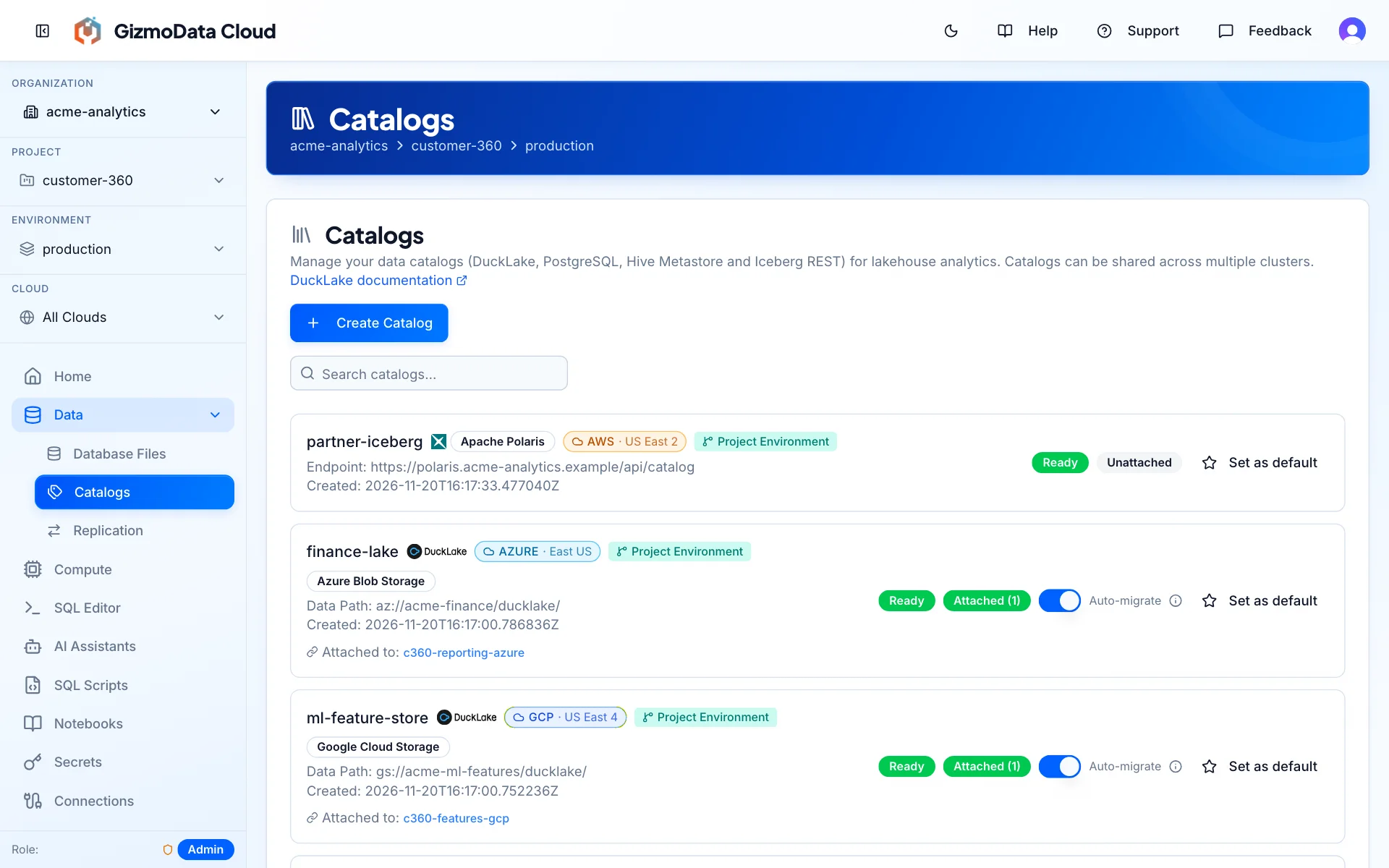
Lakehouse catalogs that follow your data — not the other way round
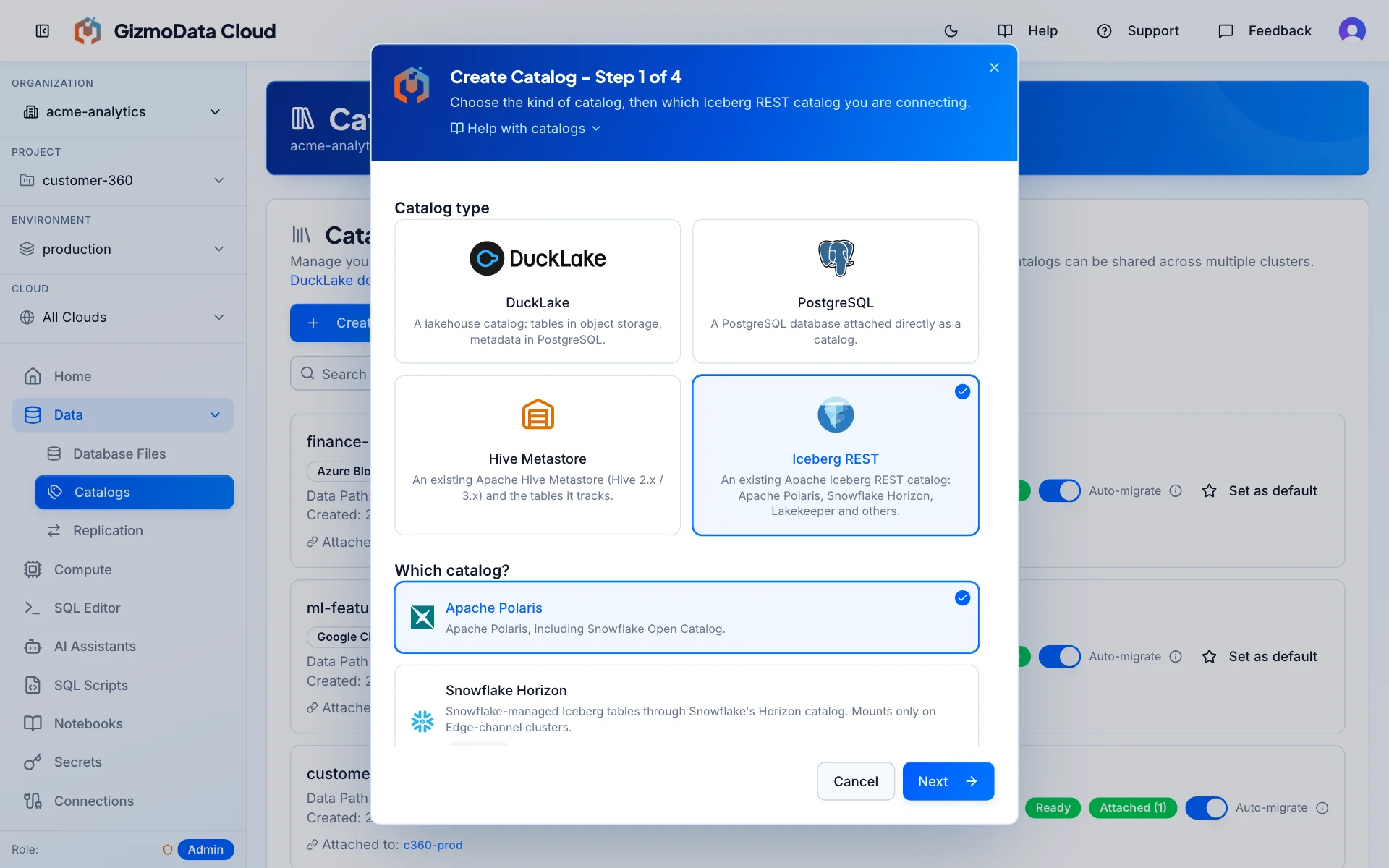
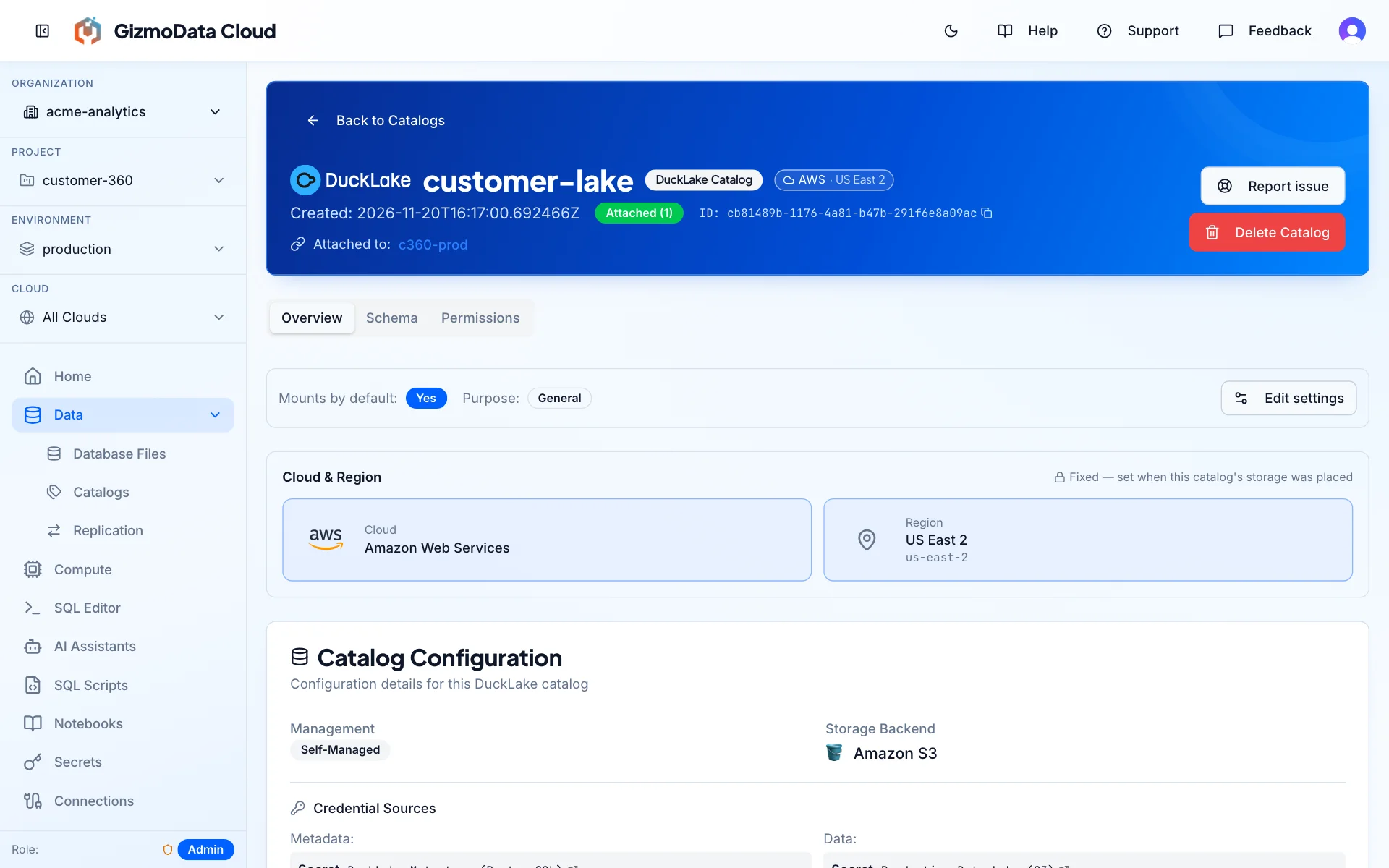
A catalog is a DuckLake (or PostgreSQL) metastore plus the object storage that holds its Parquet data — or an Apache Iceberg REST catalog you already run. Register one and mount it to as many clusters as you like; GizmoData Cloud keeps track of which clusters have it attached, migrates it automatically, and can set it as the default for a whole scope.
- DuckLake catalogs on S3, GCS, Azure Blob/ADLS or Cloudflare R2 — with a PostgreSQL metastore you bring or we manage
- Bring your own Apache Iceberg REST catalog — Apache Polaris (including Snowflake Open Catalog), Snowflake Horizon (preview) or another REST catalog such as Lakekeeper — and query its tables in place. Storage credentials can be vended by the catalog, so no bucket key is stored, and mounting one on a running cluster needs no restart
- Region-aware: each catalog knows the cloud and region its data lives in, so compute can be placed next to it
- Cross-region mount governance: organizations can block mounting a catalog from a different region, so you never pay surprise egress
- Schema browser and refresh without spinning up compute; per-catalog access rules; encrypted catalogs; history retention for instrumentation catalogs
- DuckLake maintenance: configure retention and small-file merging, and inspect the last run and catalog health in the portal
Engineering walkthrough
English narration and captions. Product captures and illustrative animations.
Credentials stored once, mounted everywhere they belong
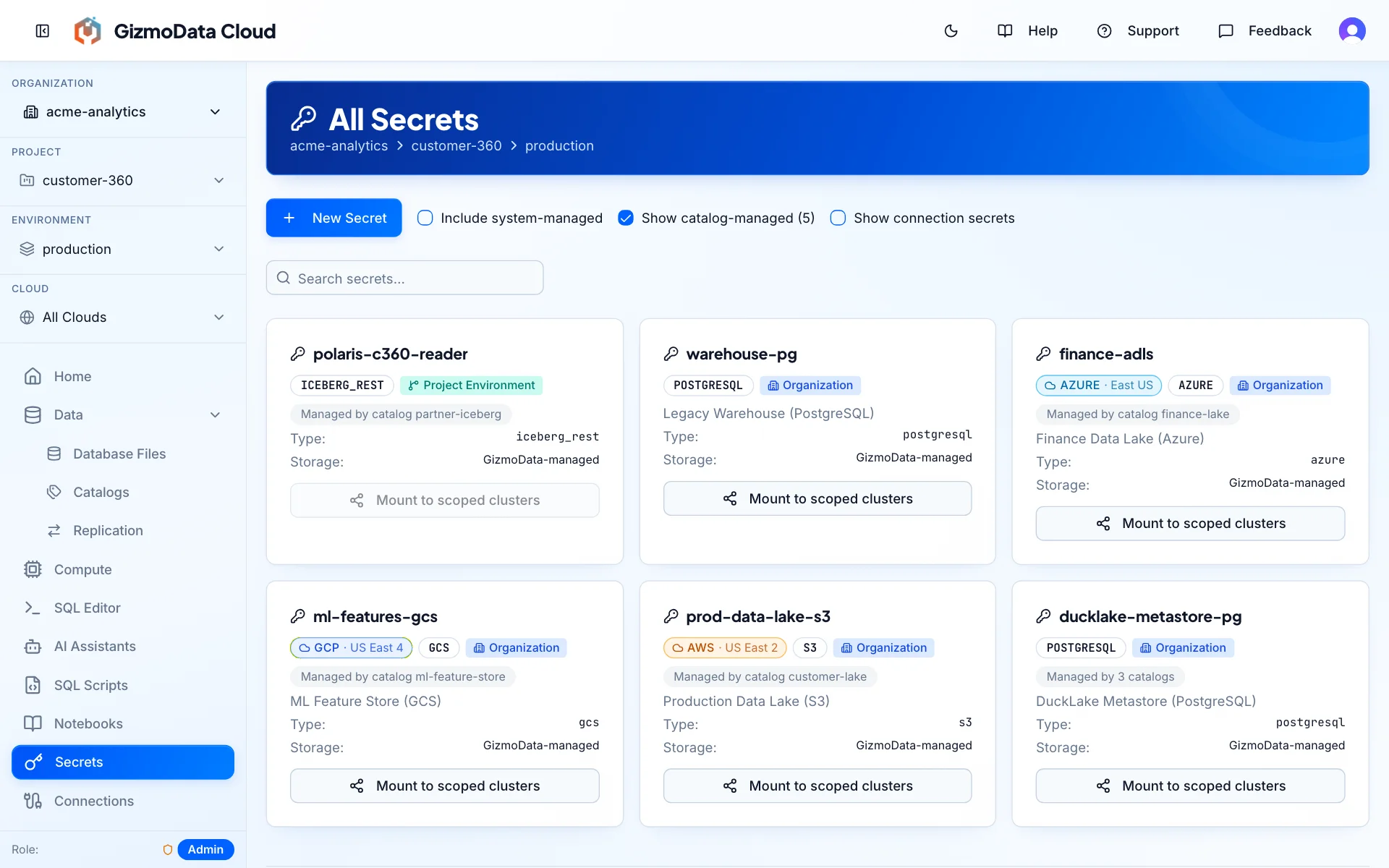
S3, GCS, Azure Storage and PostgreSQL credentials are encrypted at rest in the control plane and injected into cluster pods as DuckDB secrets at start-up. Scope a secret to an organization, project, environment or a single deployment target and it is available to every cluster underneath.
- Typed secret templates per provider — S3, GCS, Azure Storage, PostgreSQL and Iceberg REST catalog credentials
- Catalog-managed secrets are created and rotated alongside the catalog that owns them
- One-click “mount to scoped clusters” pushes a new secret to every running cluster in scope
Query any cluster from the browser — as yourself
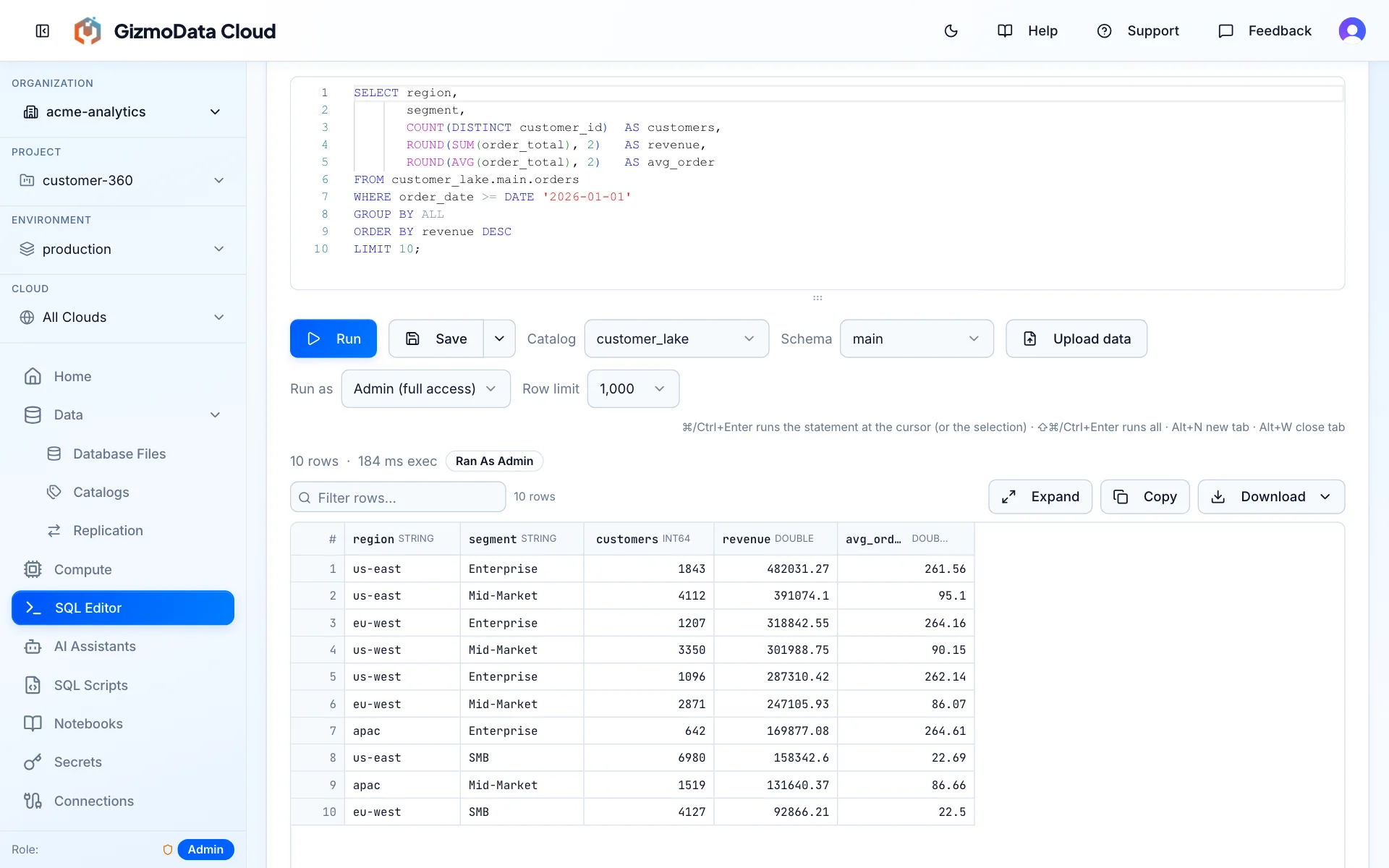
A Monaco-powered SQL editor connects to Hardcharger over Chargewire and to existing GizmoSQL clusters over Arrow Flight SQL. Sessions run under your own GizmoData Cloud permissions (admin, user or read-only), and saved SQL scripts can be attached as cluster start-up scripts.
- Multi-statement batches, run-selection, row limits and query timeouts
- Open the built-in Hardcharger web UI with your GizmoData Cloud sign-in on configured Hardcharger 2.5.0+ clusters
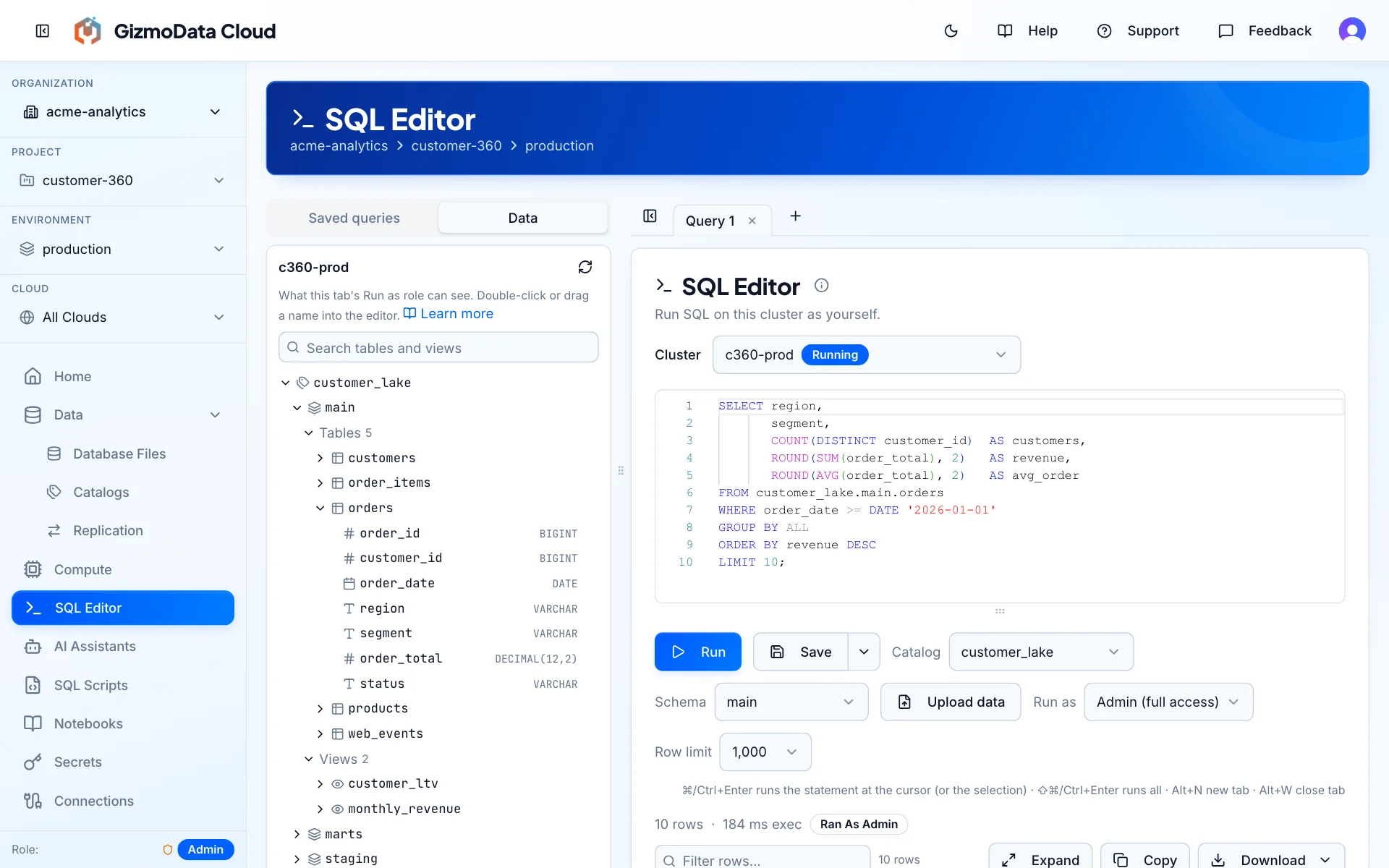
- Data explorer beside the editor: browse catalogs, schemas, tables, views and columns with their types; double-click or drag a name into the editor, preview a table, or search every catalog
- Catalog and schema pickers populated live from the engine
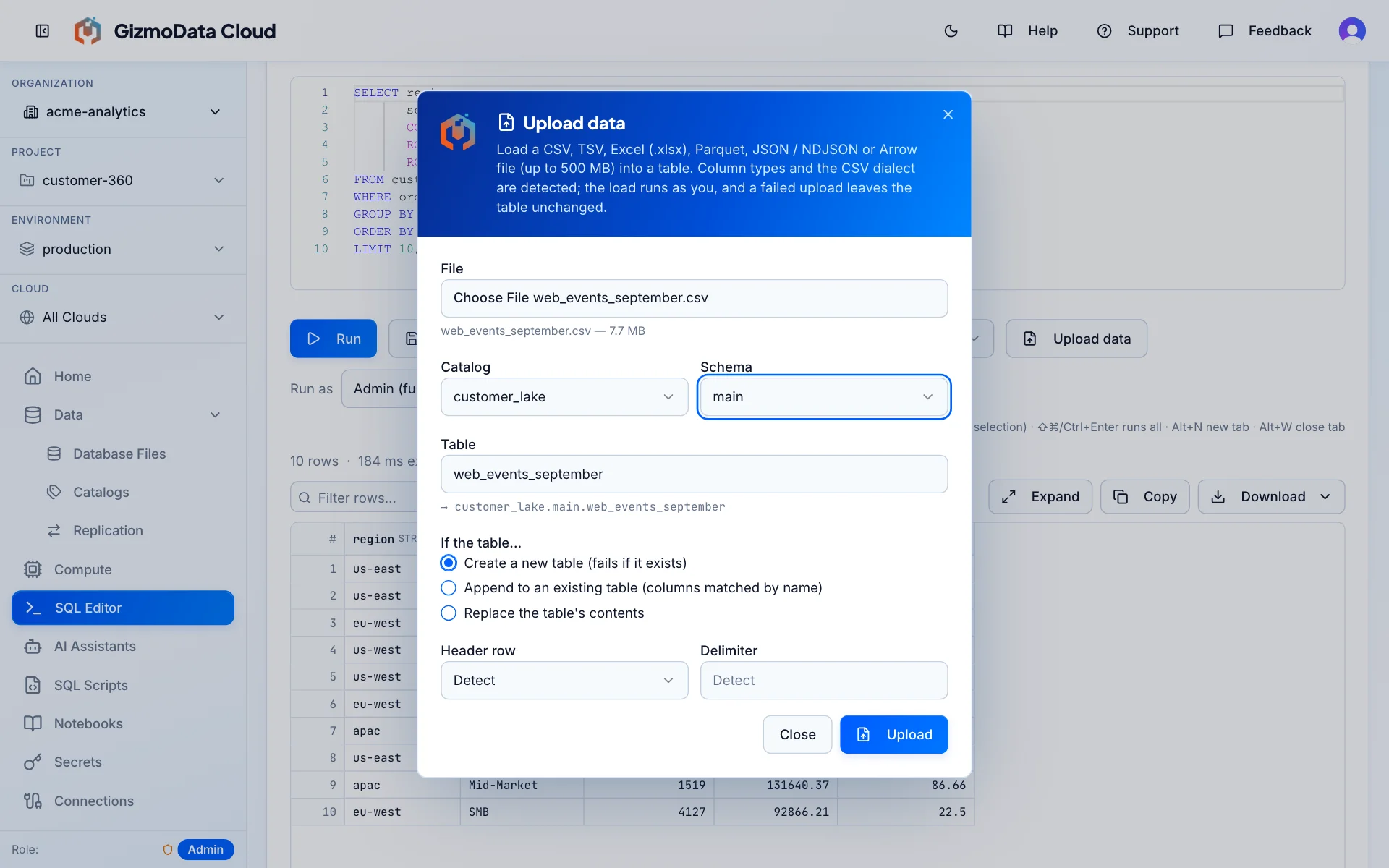
- Upload data: load a CSV, TSV, Excel, Parquet, JSON or Arrow file (up to 500 MB) into a new or existing table — column types and the CSV dialect are detected for you
- Generate a scoped connection token for DBeaver, Python (ADBC), JDBC or the command-line client
Engineering walkthrough
English narration and captions. Product captures and illustrative animations.
See what every cluster is doing — down to the engine
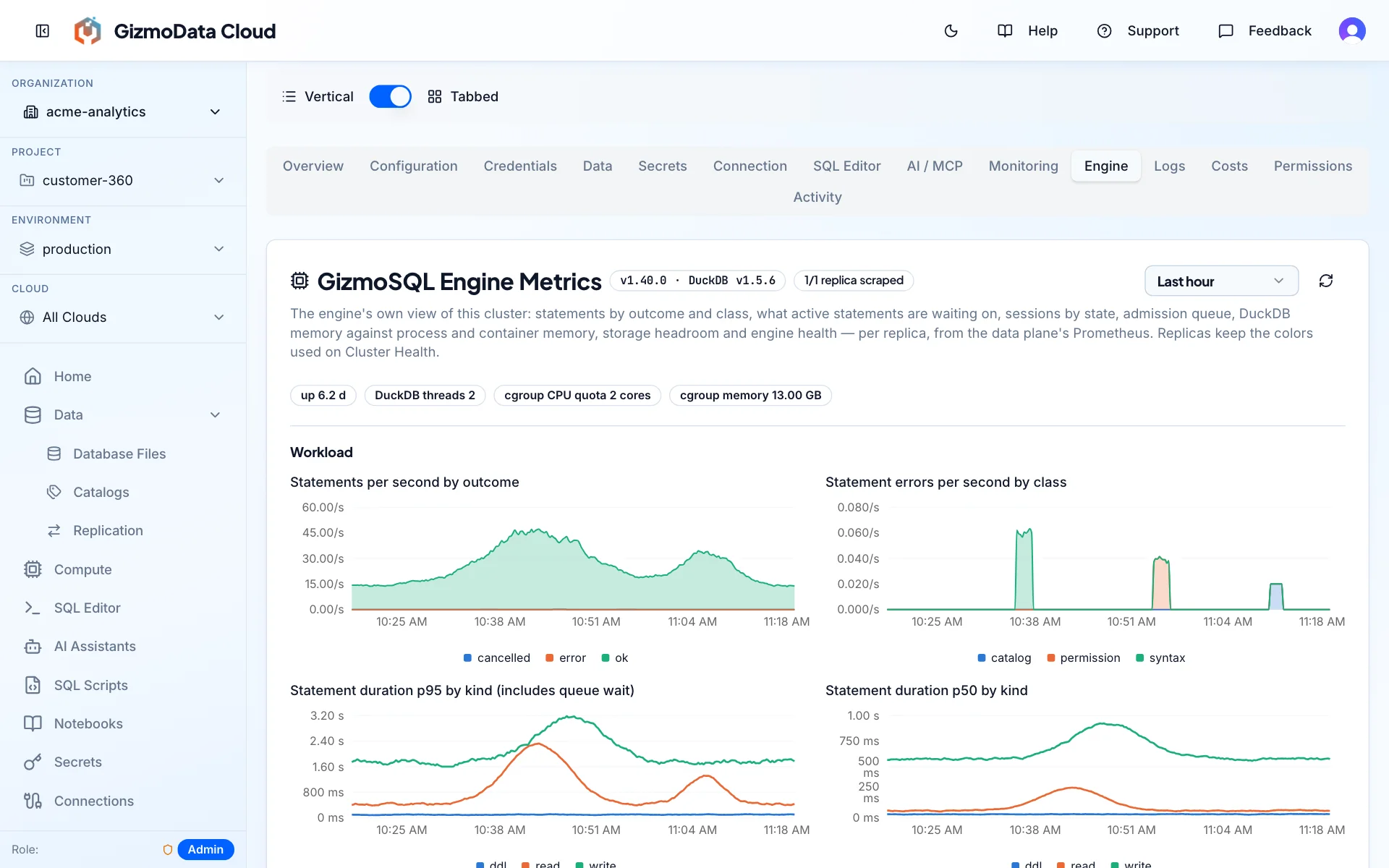
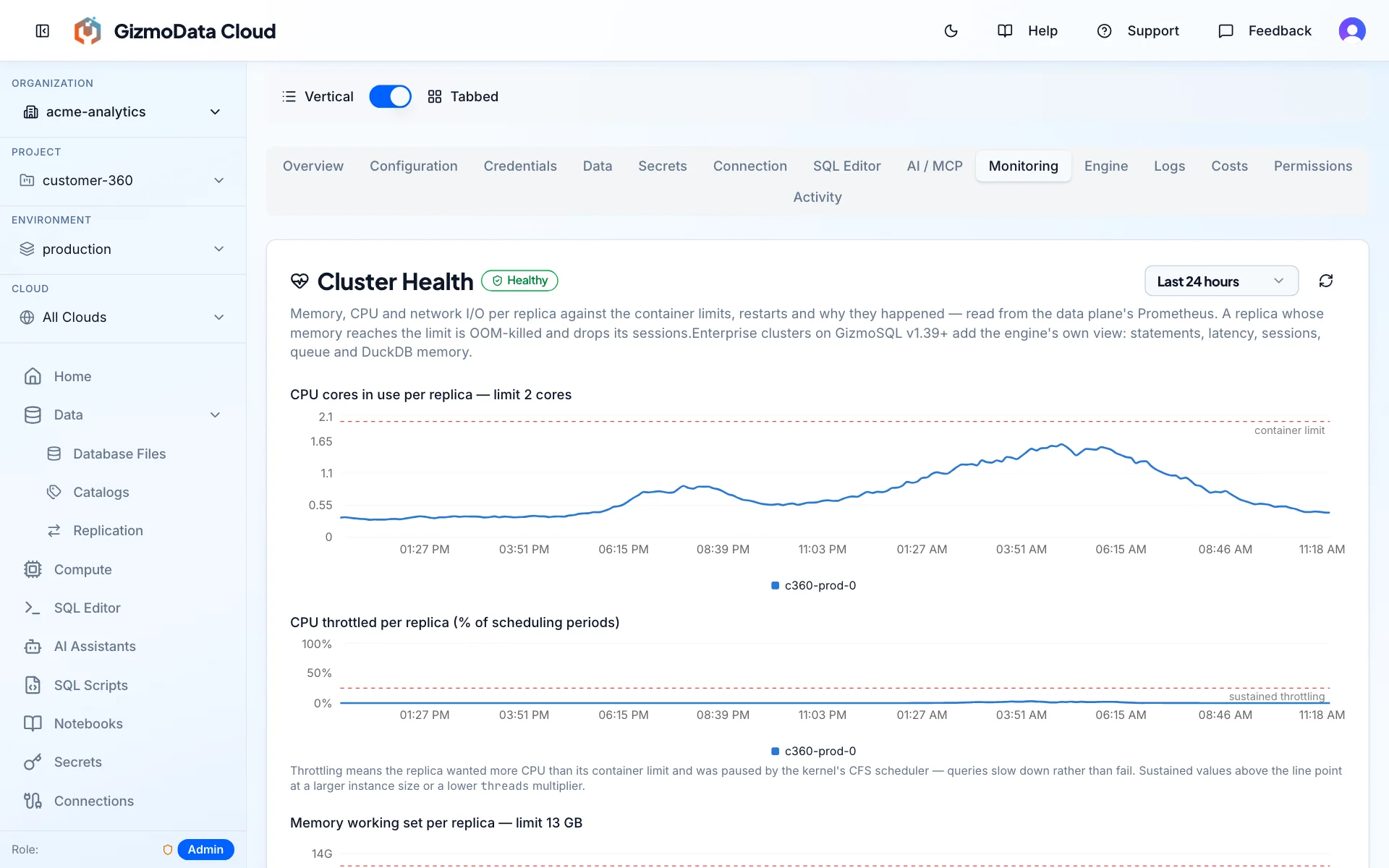
Monitor CPU, memory and network per replica against the container limits, plus restarts and out-of-memory kills with the reason they happened. Hardcharger includes engine metrics, query logs and instrumentation with no edition fee.
- Monitoring (all clusters): CPU cores and throttling, memory working set, network I/O and ready replicas — over the last hour, 6 hours, 24 hours or 7 days
- Restarts and OOM kills per replica and why they happened, with an at-a-glance health badge
- Hardcharger engine: statements per second by outcome, errors by class, and p50 / p95 latency by statement kind
- Hardcharger engine: active statements by wait state, admission queue and sessions, and DuckDB’s memory pool against process and container memory, spill and temp storage
Engine metrics come from Hardcharger’s own Prometheus endpoint and are included with every cluster.
Engineering walkthrough
English narration and captions. Product captures and illustrative animations.
Bring your data to Hardcharger, in Arrow batches
Load Oracle, PostgreSQL, Snowflake or another Hardcharger server with adbc-replicate-hardcharger. Data streams through ADBC into Hardcharger over Chargewire, with table selection, incremental loads, column masking and translated views — ready to join against your DuckLake catalogs.
Choose the data you need
Select schemas, tables and views by pattern. Copy a sample first, then load full tables or only what changed.
Control what leaves the source
Filter or mask columns in the source database before the data crosses the network. Readers see each table only after its load commits.
Keep the pipeline in Arrow
Stream Arrow record batches from the source driver to Hardcharger, with parallel loads and about one batch in client memory.
Guided where it helps, explicit where it matters
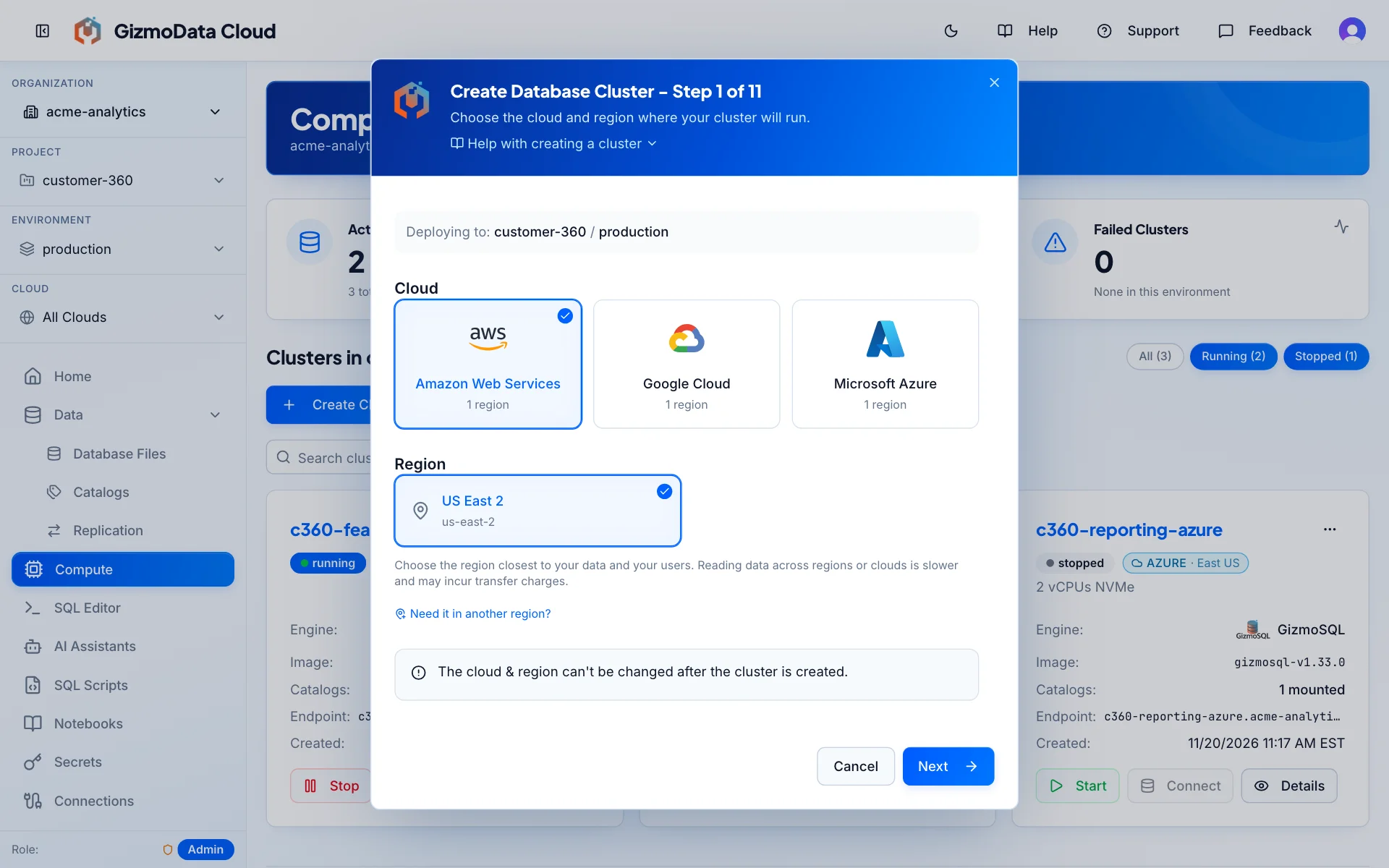
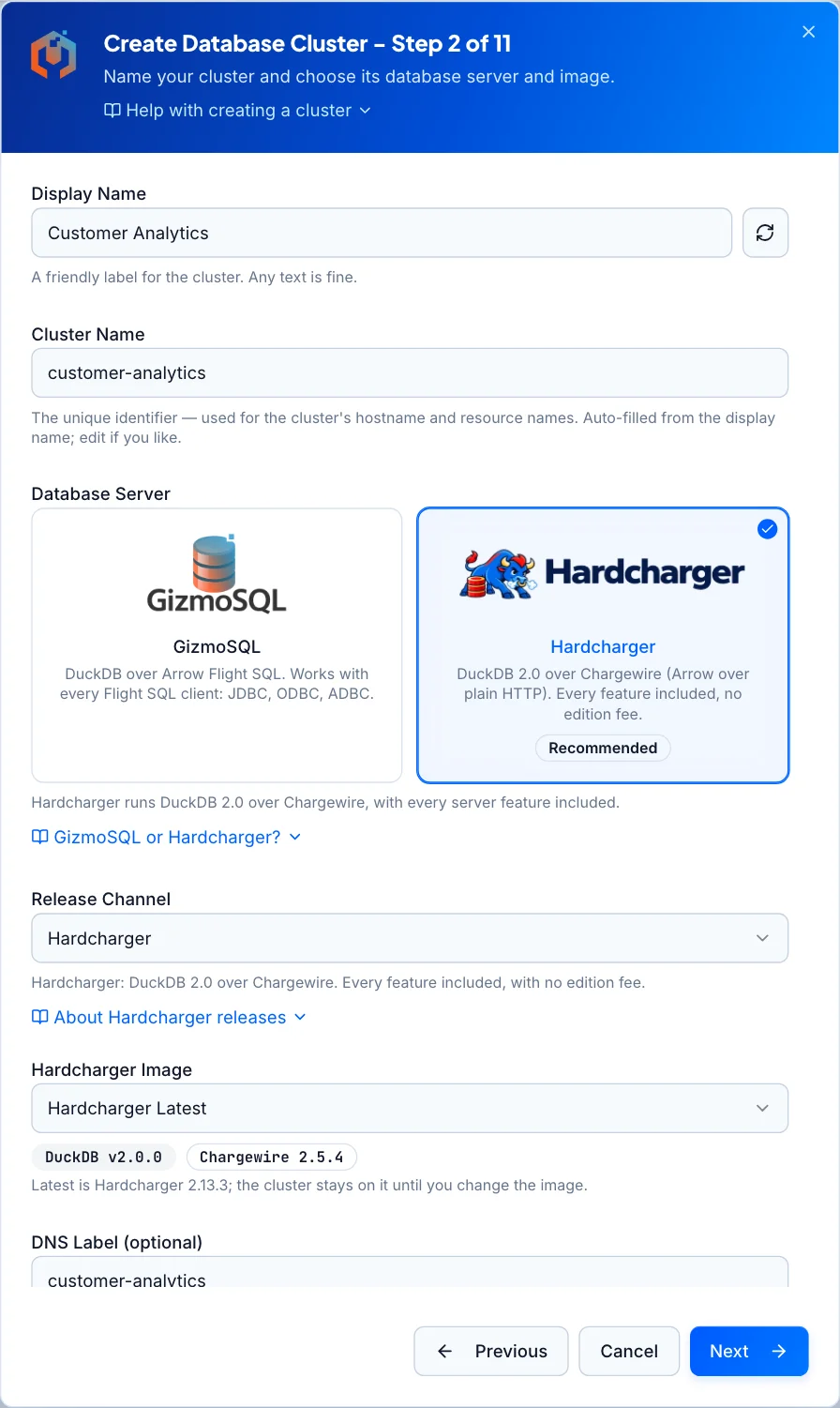
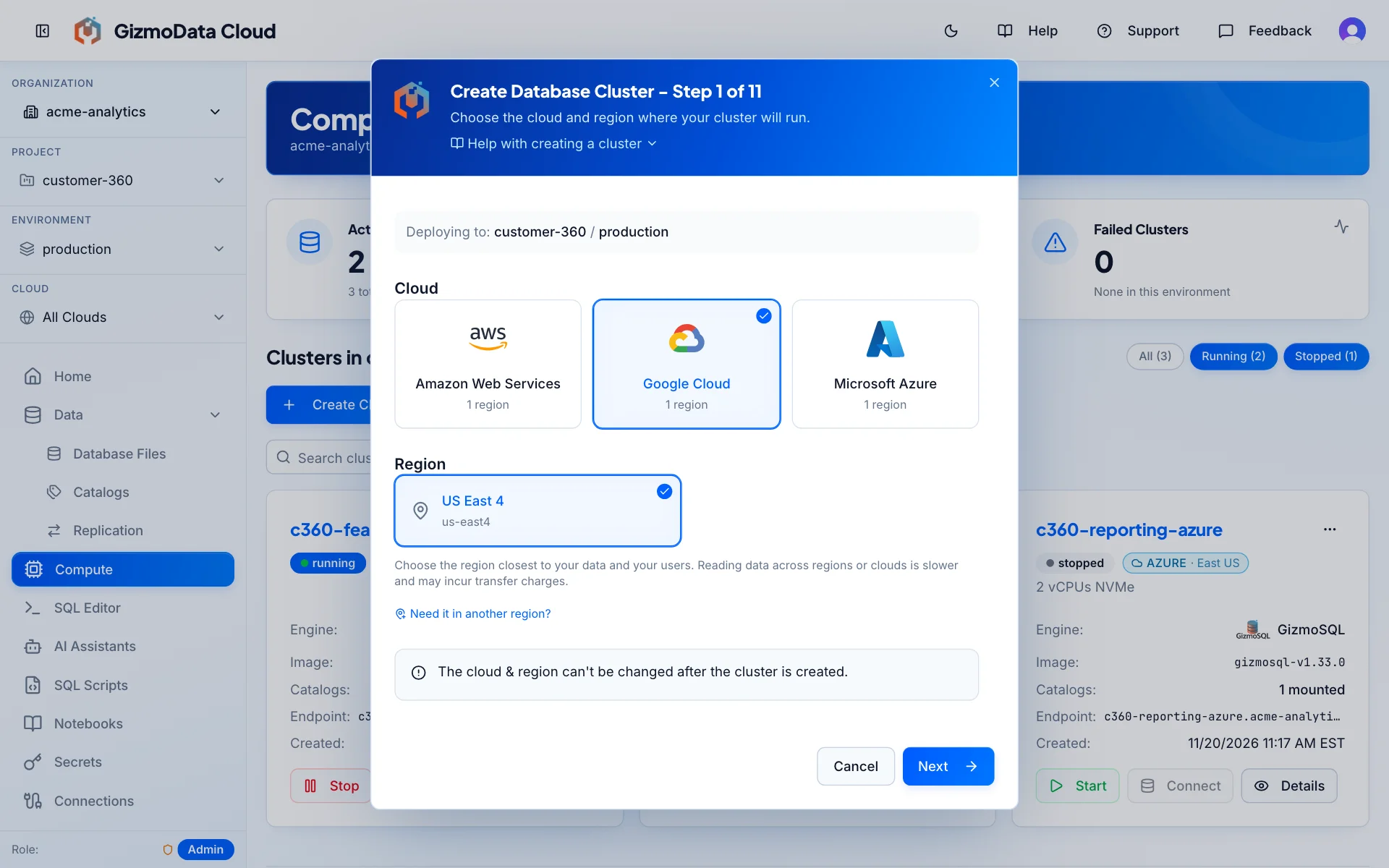
The cluster wizard walks you through cloud and region, shape, engine, catalogs, secrets, security and autoscaling — inheriting scope defaults at every step, and showing you exactly what it resolved.
The best way to run DuckDB in the cloud
A bold claim, so here is the case. DuckDB is the fastest analytical engine most teams will ever touch — but on its own it is a library. GizmoData Cloud is the platform that turns it into a secure, multi-tenant, multi-cloud service: Hardcharger for the serving, DuckLake for the data, and everything around them handled.
Real DuckDB, served properly
Hardcharger serves the actual DuckDB 2.0 engine over Chargewire: concurrent sessions, TLS, access control and Apache Arrow results over HTTP. Existing GizmoSQL clusters remain available for Arrow Flight SQL workloads.
Hardware DuckDB was made for
Single-node analytics needs memory and fast local disk. GizmoData Cloud runs Hardcharger on memory-optimised shapes with local NVMe on AWS, Google Cloud and Azure, with per-cloud thread and memory tuning applied automatically.
DuckLake as a first-class citizen
Lakehouse catalogs on S3, GCS or Azure with a PostgreSQL metastore are a native object — mountable to any number of clusters, region-aware, schema-browsable without compute, and governed so scans never silently cross regions.
Any cloud, any region, one console
A single control plane manages Kubernetes data planes in AWS, Google Cloud and Azure at once. Put compute next to each dataset and administer everything with one hierarchy, one set of roles, one audit trail.
Enterprise controls without the enterprise price tag
Scoped connection tokens, access control, firewall rules, encrypted secrets, workload identities, instrumentation catalogs and query queuing — the pieces you would otherwise bolt on yourself, already wired in.
Operated like software, not snowflakes
Every deployment is a versioned Helm release with a changelog, an automated end-to-end smoke test that provisions a real cluster and runs a query, and rollback on failure. Upgrades are boring — on purpose.
Everything else a data platform needs
Not a thin wrapper around a container — the operational layer your team would otherwise have to build.
Stop when idle, resume on connection
Opt in to automatic resume for eligible Hardcharger clusters. A valid client connection starts stopped compute; supported drivers and the hosted MCP connector wait for it.
Actual cluster costs
See billed usage for today, the last 7 days, this month and the last 30 days, plus the current rate. The monthly projection uses recent actual spend.
A timeline for every cluster
See who or what started, stopped or resumed a cluster, along with billing intervals and refused wake attempts, in its Activity view.
Organizations, projects & environments
A real hierarchy — organization → project → environment → deployment target — so production and staging never share defaults by accident.
Role-based access at every level
Admin, writer and reader roles scoped to an organization, project or environment. Invite teammates by email; roles flow down the hierarchy.
Audit trail
Every change made through the API is recorded — who, what, when and with which request — and searchable from the portal.
Autoscaling & schedules
Scale replicas on CPU and memory targets, or on a calendar: scale up for the morning dashboard rush, down for the weekend.
Firewall rules & TLS everywhere
CIDR allow-lists per cluster, TLS at the load balancer or the pod, and scoped connection tokens for Hardcharger clients.
Instrumentation & query logs
Point a cluster at an instrumentation catalog and every query, session and P99 lands in DuckLake tables you can query yourself.
Database files
Upload DuckDB files to a persistent volume with S3 backups, mount them read-only or single-writer, and import them as a background job.
Built-in support & incidents
Open a ticket from any cluster, see platform incidents in-app, and get Sev-1 SMS paging on Business and Enterprise plans.
SQL scripts & notebooks
Save SQL scripts to reuse across clusters, run them at start-up or as a step of a job, and open JupyterLab notebooks next to a Hardcharger cluster.
Search every list
Catalogs, Compute, Database Files, SQL Scripts, Secrets, Connections, Jobs, Replication and other lists filter as you type, with quick filters on Catalogs, SQL Scripts and Jobs.
GitHub token secrets
A secret for the token a job step, or Git in a notebook, uses to fetch code from a private GitHub repository. It is never mounted on a cluster.
What’s new, in the portal
After an update, the portal shows what changed since your last visit, and Help > What’s new lists every release.
Start free with $25 of credit
No credit card needed. Your $25 of trial credit runs real Hardcharger clusters; pick a plan only when it runs out.
- 1Click Start free and sign up with Google, Microsoft, Apple or GitHub
- 2Create your organization: the $25 launch credit is applied automatically
- 3Launch a cluster — no credit card until the credit is used up
Launch credit
$25
Applied automatically. No credit card needed.
$25 of trial credit for your first organization. It has no cash value; when it is used up, choose a plan to keep your clusters running.
Pricing
Prepaid tiers, no surprises. The monthly fee comes straight back as compute credit; clusters draw it down by the hour at the price you see when you create them.
Starter
$29 / month
returned in full as compute credit
- Up to 8 vCPUs running at once
- Usage beyond the credit billed at the same hourly price; charged mid-month past $100 unbilled
- Managed storage at $0.05 per GB-month
- Shared gateway included; a dedicated load balancer from $0.02 per hour
- AWS, Google Cloud and Azure regions; spot capacity at spot rates
- Python, PySpark and dbt job steps and notebooks at $0.062 per vCPU-hour plus $0.007 per GiB-hour
Try it on real data. One small cluster, or a few spot ones.
Team
$99 / month
returned in full as compute credit
- Up to 32 vCPUs running at once
- Usage beyond the credit billed at the same hourly price; charged mid-month past $300 unbilled
- Managed storage at $0.05 per GB-month
- Shared gateway included; a dedicated load balancer from $0.02 per hour
- AWS, Google Cloud and Azure regions; spot capacity at spot rates
- Python, PySpark and dbt job steps and notebooks at $0.062 per vCPU-hour plus $0.007 per GiB-hour
A team's day-to-day analytics with headroom for a big job.
Business
$499 / month
returned in full as compute credit
- Up to 128 vCPUs running at once
- Usage beyond the credit billed at the same hourly price; charged mid-month past $1,500 unbilled
- Managed storage at $0.05 per GB-month
- Shared gateway included; a dedicated load balancer from $0.02 per hour
- AWS, Google Cloud and Azure regions; spot capacity at spot rates
- Python, PySpark and dbt job steps and notebooks at $0.062 per vCPU-hour plus $0.007 per GiB-hour
Multiple environments and heavy workloads, with Sev-1 support that pages our on-call engineer.
Enterprise
Custom vCPU quotas, invoicing and contracts, dedicated tenancy, and Cloud at Customer in your own accounts.
Python, PySpark and dbt job steps and notebook sessions are billed for the time they run, by the second, at $0.062 per vCPU-hour plus $0.007 per GiB-hour of the size you choose. Replication and SQL steps have no charge of their own.
Hardcharger compute is priced per cluster-hour from the machine size and replicas you choose, with every server feature included and no edition fee. The hourly price is shown before you create or resize a cluster. Prepaid credit expires at the end of the month it was paid for; promotional credit has its own expiry and no cash value. Prices in USD; taxes may apply. See the Terms of Service and Refund Policy.
Frequently Asked Questions
What is GizmoData Cloud?
GizmoData Cloud is the fully managed home for Hardcharger, GizmoData’s DuckDB 2.0 server over Chargewire, and existing GizmoSQL clusters. The portal and API at app.gizmodata.com manage compute, DuckLake catalogs, secrets and infrastructure across AWS, Google Cloud and Microsoft Azure, with organization/project/environment scoping, role-based access and an audit trail.
What is the GizmoData Cloud starter kit?
One click (or one tick when you sign up) sets up a complete place to work: a DuckLake data lake, an instrumentation catalog, an access-control (RBAC) store and a logging catalog, and a 2-vCPU Hardcharger cluster that uses them, with its own dedicated load balancer, managed credentials and Sign in with GizmoData Cloud. All that is left is to click Connect. Where GizmoData has an organization built ahead of time in your region, your first organization is that one, ready in moments; otherwise the kit is set up after your first project, in about 10 minutes. The form shows what its cluster costs per hour, running and stopped, before you start. The cluster starts at 2 vCPUs and can be resized any time with Edit Configuration: a running cluster restarts briefly on the new size and keeps its address, and a stopped one takes the new size on its next start. It stops after 15 minutes without queries, and every piece is an ordinary catalog or cluster you can change or delete. Already have an organization? Recommended setup on the Compute page makes the same kit in any project and environment.
Which clouds and regions does GizmoData Cloud support?
The data plane runs on Kubernetes in AWS (EKS), Google Cloud (GKE) and Microsoft Azure (AKS). Self-serve organizations launch today in AWS US East 2 (Ohio), Google Cloud us-east4 (Northern Virginia) and Azure East US 2 (Virginia). Because catalogs are region-aware, GizmoData Cloud can place compute next to your data and can block cross-region mounts that would incur egress.
Can I get GizmoData Cloud in my region?
Yes. If you need compute in a region we do not run yet, for latency, to sit next to your data, or for data residency, request it at gizmodata.com/contact. New regions are available to Business and Enterprise customers: we can stand up a new AWS, Google Cloud or Azure region quickly, often in less than one day. Starter and Team organizations use the regions listed above.
Is the control plane tied to one cloud?
No. The control plane is cloud-agnostic and can manage Kubernetes clusters in several clouds at once. GizmoData also offers Cloud at Customer, where the control plane and data planes run inside your own cloud account — see gizmodata.com/cloud/at-customer.
What is a DuckLake catalog?
DuckLake is the open lakehouse format from the DuckDB team: a SQL metastore (PostgreSQL) plus Parquet files in object storage. In GizmoData Cloud a catalog bundles the metastore credentials, the storage credentials and the data path, so it can be mounted to multiple Hardcharger clusters and shared across teams. For more details, see ducklake.select(opens in a new tab).
Can I keep using my existing GizmoSQL clusters?
Yes. Existing GizmoSQL clusters and Arrow Flight SQL clients remain supported in the same console. Keep them for workloads that depend on GizmoSQL-specific extensions, such as Hive Metastore or ADBC SQL federation. Choose Hardcharger for new DuckDB 2.0 workloads and use its Chargewire clients; shared DuckLake catalogs with a PostgreSQL metastore can keep data accessible to both servers.
Can GizmoData Cloud run federated queries against Snowflake, Oracle or other databases?
Yes, on Hardcharger clusters. Save a connection to PostgreSQL, Snowflake, Oracle Database, IBM Db2, Quack, Hardcharger or GizmoSQL once, mount it on a cluster, and query its tables with SQL next to your own data. To keep a copy in Hardcharger instead, a replication copies tables and views from PostgreSQL, Oracle Database, Snowflake or another Hardcharger server on a schedule. For existing GizmoSQL workloads, ADBC SQL federation remains available through the matching DuckDB community extensions. The bundled ADBC drivers and server-side SQL extensions are separate components; extension availability depends on the DuckDB version.
What can scheduled jobs do in GizmoData Cloud?
A job runs steps on a Hardcharger cluster, on a schedule or with Run now. Replication steps copy tables and views in from PostgreSQL, Oracle Database, Snowflake or another Hardcharger server; SQL steps run SQL; Python and PySpark steps run your own code; and dbt steps run a dbt Core project from a GitHub repository, with the connection supplied for you. Steps form a graph, every run keeps its history and logs, and your organization can get a Slack message when a job starts failing. Python, PySpark and dbt steps run where a data plane offers them: today that is AWS US East 2 (Ohio).
Can I use Jupyter notebooks with GizmoData Cloud?
Yes. Start a JupyterLab session next to a Hardcharger cluster and it opens already signed in to the cluster as you, with Python and PySpark kernels, %%sql cells, Git, starter notebooks and a workspace that keeps your files between sessions. Notebooks run where a data plane offers them: today that is AWS US East 2 (Ohio).
Can I try DuckDB 2.0 on GizmoData Cloud?
Yes. Choose Hardcharger as the database server in the cluster wizard: it runs DuckDB 2.0 over Chargewire, with native ADBC, JDBC and JavaScript clients. GizmoSQL remains available for existing Arrow Flight SQL workloads. A DuckDB 2.0 database file cannot be opened by older DuckDB versions; use shared DuckLake catalogs with a PostgreSQL metastore when keeping data accessible to both servers.
Can I use my own storage?
Yes, for your data. The compute is fully managed: Hardcharger clusters run on GizmoData-managed Kubernetes in the cloud and region you pick, so there is no infrastructure to register or operate. Your DuckLake catalogs can use GizmoData-managed storage or point at your own buckets and PostgreSQL metastores, with the credentials stored as encrypted secrets. If you need the whole platform, compute included, inside your own cloud accounts, see Cloud at Customer at gizmodata.com/cloud/at-customer.
Can I ask Claude or another AI assistant about my data in GizmoData Cloud?
Yes. Add the GizmoData connector, https://mcp.gizmodata.com/mcp, to Claude, Claude Code or any MCP client and sign in with your GizmoData Cloud account. Your assistant can then query every Hardcharger cluster you can see, and every statement runs as you: Hardcharger applies your grants, row policies and masking, and its audit log records who asked. There are no passwords or tokens to copy, and when you lose access to a cluster, your assistant loses it too.
How is GizmoData Cloud priced?
Self-serve plans are prepaid tiers: Starter ($29/month, up to 8 vCPUs running at once), Team ($99/month, 32 vCPUs) and Business ($499/month, 128 vCPUs). The monthly fee comes back in full as compute credit, clusters draw it down at the hourly price shown when you create them, and usage beyond the credit is billed at that same price. Shared compute sizes (Pico, Nano and Micro) start at $0.028 per hour for development and light workloads. Managed storage — DuckLake catalog data and cluster data volumes — is $0.05 per GB-month. Every cluster reaches clients through the shared gateway of its region at no extra charge; a cluster that wants a load balancer of its own adds from $0.02 to $0.045 per hour depending on the cloud, shown when you create it. Enterprise plans with custom quotas, contracts and Cloud at Customer are priced by agreement.
What happens to unused credit, and can I get promotional credit?
Prepaid compute credit is good for the month it was paid for and expires at the end of that billing period. Promotional credit — from an invitation or from GizmoData — is a gift with its own expiry, applies to metered usage only and has no cash value. Your billing page shows both kinds separately, what each has left, and how the current period is being covered.
How are job steps and notebooks billed?
Python, PySpark and dbt steps and notebook sessions are billed for the time they run, by the second, at $0.062 per vCPU-hour plus $0.007 per GiB-hour of the size you choose. Replication and SQL steps have no charge of their own: the time they keep a cluster running is billed as cluster time, as before. A run’s page shows what its steps came to, a job’s page its last 30 days, and Organization > Usage a line for each job and notebook session.
How does automatic resume work?
Enable Auto-resume on an eligible Hardcharger cluster and start it once. After it stops, a client connection with valid credentials starts it again at the same hostname. Pair it with Stop when idle to stop compute between periods of use. Supported drivers and the hosted MCP connector wait for startup. Opening the web UI or using the portal SQL editor does not wake a stopped cluster; use Start for those.
Which clusters support automatic resume?
Auto-resume is off by default. It requires Hardcharger, managed authentication and one fixed replica with autoscaling off. Clusters with an access-control store require Hardcharger 2.6.0 or later. Supported clients include Python ADBC 2.3.0+, JDBC 2.3.0+, JavaScript 2.2.0+ and ODBC 1.3.0+; older clients may need to reconnect after startup. Billing and quota checks still apply.
How long does a resume take, and what is billed while stopped?
Allow about 30 seconds on shared compute and a few minutes on dedicated compute, where a machine may need to launch. Times vary with capacity, startup scripts and data loading. Compute charges resume when the cluster is running. A dedicated load balancer retained for auto-resume is billed while stopped; the shared gateway has no additional endpoint charge. Managed storage remains separately billed.
How do I sign up?
GizmoData Cloud is generally available and open to everyone: sign up at app.gizmodata.com (Google, Microsoft, Apple or GitHub), create your organization and launch your first cluster. For launch, signing up through any Start free button on this site gives your first organization $25 of trial credit, applied automatically, so you can start without a credit card; you choose a plan when the credit runs out. If you already run GizmoSQL Enterprise, we can host it for you too.
From the Blog
Benchmarks, launches and architecture deep dives on GizmoData Cloud

Schedule Pipelines, Work in Notebooks and Connect Your Databases on GizmoData Cloud
Scheduled jobs with Replication, SQL, Python, PySpark and dbt steps, JupyterLab notebooks next to your data, and saved connections to the databases you already have, with S3 access without keys. Every run shows what its code steps cost.

Introducing Hardcharger™: The DuckDB 2.0 Server, Built on the Open Chargewire Protocol
Our new open-source DuckDB 2.0 server speaks Chargewire, an open protocol for SQL over HTTP with Arrow results. 22 queries derived from TPC-H over 1 TB in 42.4 s on one Graviton5 machine, about 9 cents of compute, and every feature included: RBAC, SSO, mTLS, audit and a web UI. No license keys.
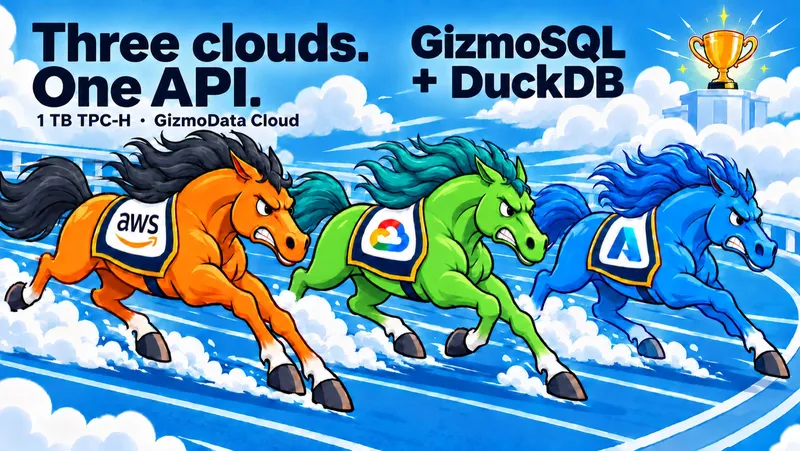
Three Clouds, One API: A 1 TB Horse Race Derived from TPC-H on GizmoData Cloud (AWS vs. Google Cloud vs. Azure)
Six 64-vCPU GizmoSQL clusters on AWS, Google Cloud and Azure raced a 1 TB workload derived from TPC-H on local NVMe and DuckLake. Graviton5 ran the fastest lap (79 s, $0.30), Google Cloud took four of six golds, and DuckDB 2.0 won every lane. 38 minutes, about $37, one API.
Run Hardcharger where your data lives — we handle the operations
Sign up, create your organization and have a Hardcharger cluster running in minutes — on AWS, Google Cloud or Azure. Need custom quotas or a contract? Talk to us.