
DB Olympics is a new, open SQL benchmark from Altan Birler and Tobias Schmidt of the database group at the Technical University of Munich. Instead of a fixed set of textbook queries, it simulates an online retailer, Tidewick Commerce, and lets AI agents play its people: the CEO, the CFO, data analysts, the security chief and more. Their questions became 409 SQL queries, which every system runs on AWS machines at four sizes, from 1 GB to 1 TB, with each answer checked against a reference result.
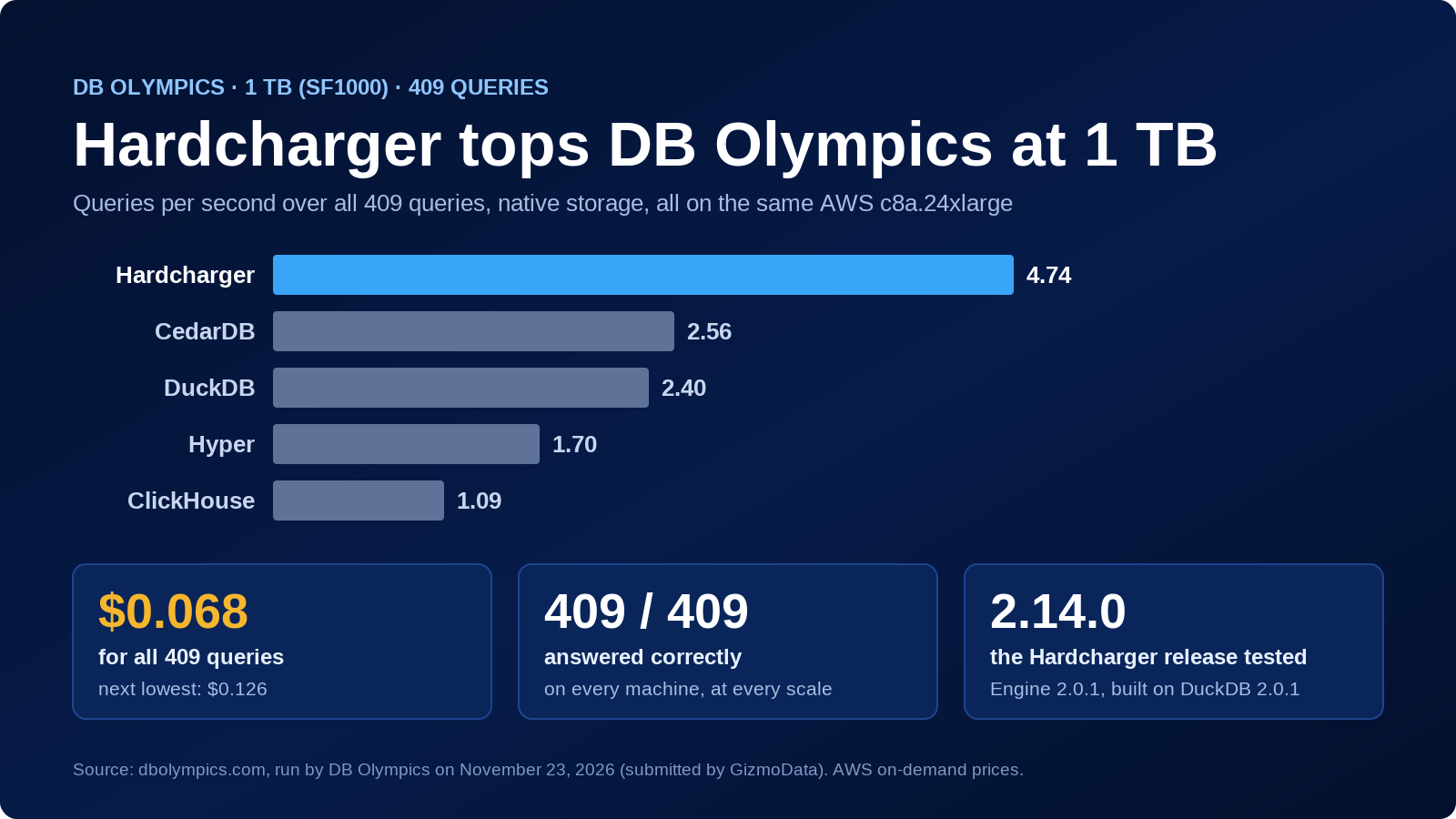
We submitted Hardcharger 2.14.0 on November 22, and DB Olympics ran it the next day. At 1 TB, Hardcharger has the highest throughput and the lowest cost of every system on the board, and it is the only released database that answered all 409 queries correctly on every machine at every scale.
Leaderboards move, and this one is only weeks old. We expect the other systems to catch up, some of them soon. But on November 23, at 1 TB, Hardcharger is on top, and we'll take it.
The results at 1 TB
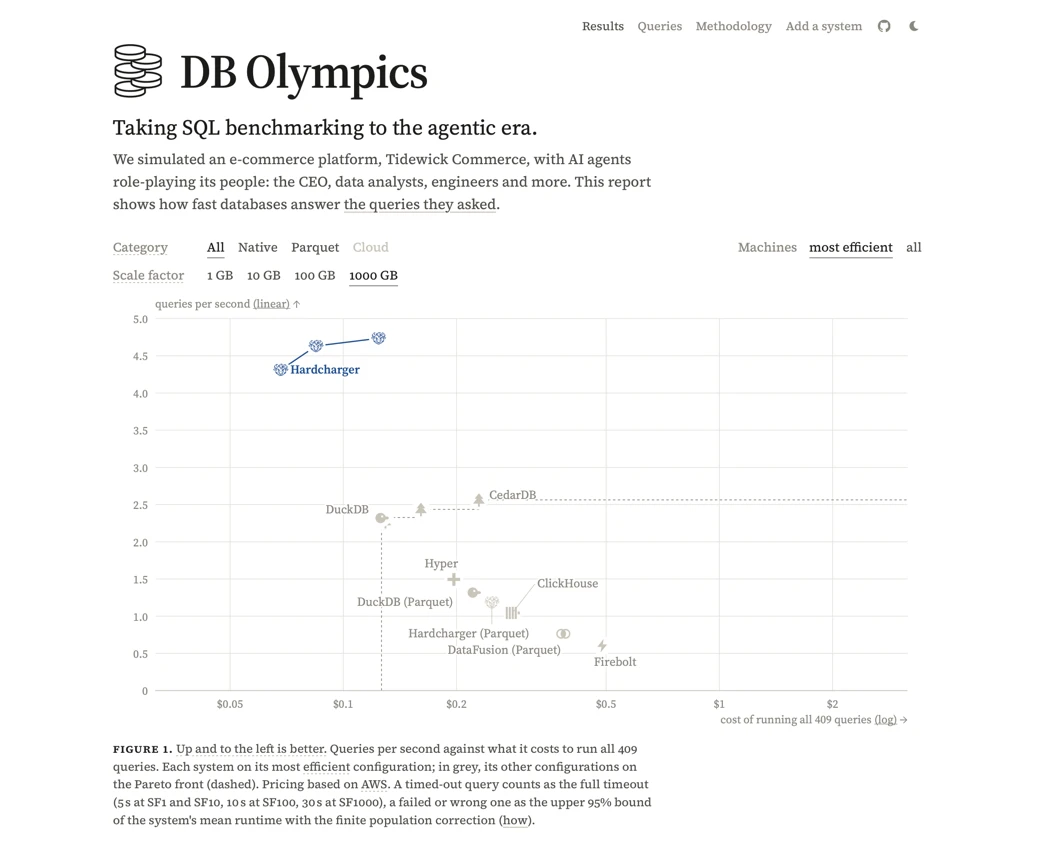
DB Olympics scores a system by the time it takes to run all 409 queries once after its last data load. Queries per second is 409 divided by that time, and cost is that time at the machine's AWS on-demand price. A query that runs past the timeout (30 seconds at 1 TB) counts as the full 30 seconds. This is every system on the largest machine, a c8a.24xlarge with 96 vCPUs and 192 GB of memory, each with its own storage format:
| System | Queries per second | Cost of all 409 | Slowdown | Correct |
|---|---|---|---|---|
| Hardcharger | 4.74 | $0.124 | 1.40× | 409 |
| CedarDB | 2.56 | $0.229 | 1.35× | 408 |
| DuckDB | 2.40 | $0.244 | 1.58× | 407 |
| Hyper | 1.70 | $0.346 | 1.66× | 404 |
| ClickHouse | 1.09 | $0.538 | 4.20× | 349 |
| DataFusion (Parquet) | 0.97 | $0.605 | 4.84× | 317 |
| Firebolt | 0.61 | $0.959 | 4.39× | 381 |
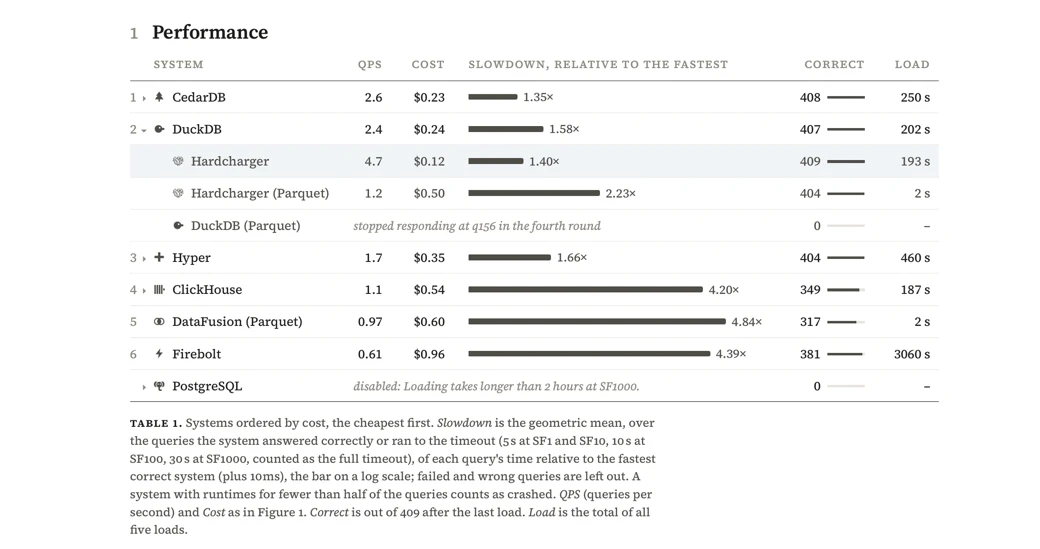
c8a.24xlarge. The site lists Hardcharger as a variant of DuckDB, the engine it builds on, and ranks only the base systems, so Hardcharger's row (highlighted) has no rank number of its own. Screenshot of dbolympics.com, November 23, 2026.Hardcharger answers 1.85 times as many queries per second as CedarDB and almost twice as many as DuckDB, for about half the cost. The lowest cost on the board comes from a smaller machine: on a c8a.12xlarge (48 vCPUs, 96 GB), Hardcharger ran all 409 queries for $0.068, against $0.126 for DuckDB and $0.129 for CedarDB there. Its 4.31 queries per second on that machine are more than any other system managed on any machine.
Slowdown is DB Olympics' other measure: the geometric mean of how far each query is from the fastest system's time on it. It rewards the typical query rather than the total, and on the largest machine CedarDB is ahead on it, 1.35 to our 1.40. On the c8a.12xlarge and c8a.16xlarge, Hardcharger's slowdown is the lowest. CedarDB is faster than Hardcharger on more than half of the individual queries at 1 TB; Hardcharger wins on the total because it has no slow outliers. Its slowest query took 6.3 seconds. CedarDB's slowest answer took 16.6 seconds, and one more query timed out; DuckDB had two timeouts.
A note on what was measured. DuckDB runs embedded inside the benchmark program. Hardcharger runs as a server: the benchmark sent every query to hardcharger-server through the Hardcharger ADBC driver, over Chargewire on the same machine, and fetched every result. So Hardcharger's times include a client-server round trip that the embedded DuckDB entry doesn't pay.
All 409, everywhere
DB Olympics ran Hardcharger in 16 configurations: four scale factors (1 GB, 10 GB, 100 GB and 1 TB), each on three or four machine sizes. Hardcharger answered all 409 queries correctly in all 16, with no wrong result, no error and no timeout. The only other system to do that is Querybrew on ClickHouse, an experimental system from the DB Olympics authors in which their research database, Umbra, rewrites every query for ClickHouse; it isn't a released product, and at 1 TB it ran at about a quarter of Hardcharger's throughput. Among released systems at 1 TB, CedarDB answered 408 and DuckDB 407.
The query that started a fork
Query 318 was asked by the simulated Chief Information Security Officer:
"Since shopper accounts have 0% MFA, what actually stands in for a second factor today: are most shoppers authenticating through an OAuth provider (Google/Apple/etc., which carries its own security), or are they overwhelmingly raw password-only accounts with no backup at all?"
At its heart is a join of shoppers to their login attempts on the tenant and either the user ID or the email address:
join login_attempts la
  on la.tenant_id = s.tenant_id
 and (la.user_id = s.id or la.email = s.email)
The tenant is a weak key: it matches every shopper of a merchant to every login attempt of that merchant, and the or can't be used to look rows up, so an engine ends up checking a huge number of candidate pairs. At 1 TB on the c8a.24xlarge:
| System | Query 318 at 1 TB |
|---|---|
| Hardcharger | 0.25 s |
| Querybrew on ClickHouse (experimental) | 0.55 s |
| ClickHouse | 6.15 s |
| Firebolt | 7.29 s |
| CedarDB, DuckDB, Hyper, DataFusion (Parquet) and Hardcharger (Parquet) | timed out at 30 s |
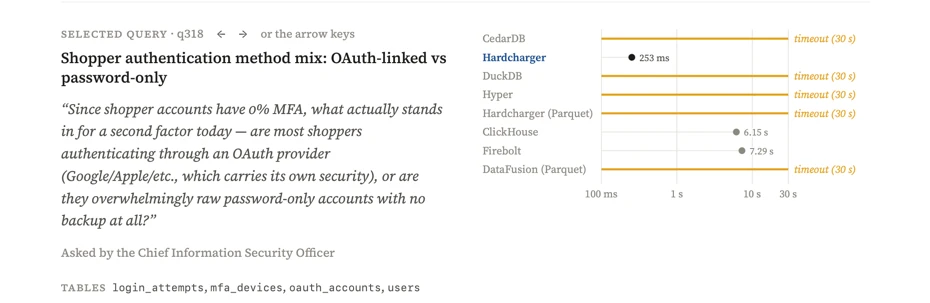
We'll be upfront: this is the query that made us fork. DB Olympics' first run of Hardcharger, version 2.0.0 on stock DuckDB 2.0.0 in late October, timed out on it at 10 GB and above, and the fix needed a change inside DuckDB's optimizer. So we started Hardcharger Engine, our performance fork of DuckDB, to ship and test such changes on Hardcharger's release schedule. Its first optimizer rule handles joins of this shape in general, not query 318 by name: for an eligible inner join under a DISTINCT, it builds two selective joins, one on tenant and user ID and one on tenant and email, and lets the existing DISTINCT remove the overlap. It applies only when it can prove the answer is unchanged, and it ships with its own regression tests. In our own test at 10 GB on a laptop, swapping stock DuckDB 2.0.1 for our engine took query 318 from 3.67 seconds to 19 milliseconds.
tenant_id alone and checks the OR condition on every candidate pair. Right: Hardcharger Engine runs two selective joins and lets the query's own DISTINCT remove the overlap. An illustration, not to scale.Two caveats, because they matter. Our Parquet configuration still timed out on query 318, so the rule doesn't help there yet. And at 100 GB, query 318 is what puts Hardcharger ahead: without it, CedarDB would be slightly faster on the c8a.12xlarge, 26.7 queries per second to our 25.1. At 1 TB the lead holds without it. Take query 318 out of every system's total on the c8a.24xlarge and Hardcharger still answers 4.74 queries per second, against 3.15 for CedarDB and 2.91 for DuckDB. At 10 GB and 1 GB, CedarDB leads outright.
One more: query 360
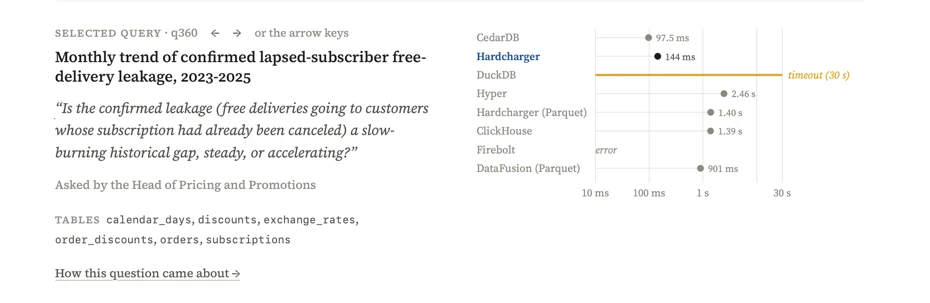
The simulated Head of Pricing and Promotions asked whether free deliveries going to customers whose subscription had already been canceled were "a slow-burning historical gap, steady, or accelerating". Here we don't win: at 1 TB on the c8a.24xlarge, CedarDB answered in 97.5 milliseconds and Hardcharger in 144. But stock DuckDB timed out at 30 seconds, and the next systems took from 0.9 to 2.5 seconds. The query joins orders to calendar days and exchange rates on a timestamp cast to a date, the shape another of our engine changes is aimed at: a better estimate of how many rows such a join produces. We haven't isolated that change as the reason (the DuckDB entry ran 2.0.0, a patch release behind our engine's base), so we'll just report the times.
Standing on the shoulders of ducks
None of this exists without DuckDB. Hardcharger Engine 2.0.1 is DuckDB 2.0.1 with 14 performance commits on top, plus the hooks the Hardcharger server needs. The SQL, the execution engine, the storage and the database file format are DuckDB's, built by the incredible team at DuckDB Labs and DuckDB's many contributors, and released under the MIT license. Thank you. The 409 queries ran on your work.
One of those contributors, in a small way, is our founder, Philip Moore (prmoore77). Three of his pull requests are in DuckDB itself: the struct_insert function, HUGEINT support for bit_count and new information_schema views. Not many, but it means we've helped build the engine we know and love, not just build on it.
We'll take a little of the credit too. Our share of the result is:
- The engine changes. Besides the join rule, the fork estimates timestamp-to-date joins better, applies integer range filters in one pass, reuses checks in filtered column scans, starts scan read-ahead sooner, and speeds up substring search and regular expression extraction. Each change is documented with its limits, its tests and what we measured.
- The server around it. Hardcharger turns the engine into a multi-user server with sign-in, access control and an Arrow-native protocol, Chargewire, and it scored these numbers as a server, answering over the wire.
Thank you as well to Altan Birler and Tobias Schmidt for DB Olympics: an open benchmark where anyone can add a system, every result is checked, and the queries come from questions people would actually ask. Finding query 318 made our engine better.
And on ClickBench
We submitted Hardcharger 2.14.0 to ClickBench as well, and it was merged on November 22. On ClickBench's default combined score, as of November 23, Hardcharger places 6th of 93 entries on the c7a.metal-48xl and 6th of 91 on the c8g.metal-48xl, the highest-placed DuckDB-based system on both, behind Rayforce, CedarDB, ClickHouse and chDB. On the smaller c6a.4xlarge it is 9th of 102, a hair behind our own GizmoSQL entry from May. Cold runs, the first run of each query after a restart, are our weak spot there, and the next thing we want to improve.
The details
- Hardcharger: version 2.14.0 on Hardcharger Engine 2.0.1 (DuckDB 2.0.1), queried through the Hardcharger ADBC driver 2.7.2. The DuckDB entry ran DuckDB 2.0.0.
- Run: by DB Olympics' own runner on November 23, 2026, on AWS
c8amachines (AMD EPYC), each system limited to the machine's cores and 80% of its memory, with data loaded from Parquet in five periods and the queries timed after the last load. - Numbers: computed from DB Olympics' published data with its own formulas (the site rounds them); prices are AWS on-demand, $2.5865 an hour for the
c8a.12xlargeand $5.173 for thec8a.24xlarge. - See it for yourself: the results, query 318, the methodology and Hardcharger's entry in the DB Olympics repository. Hardcharger isn't one of the site's core systems: it is listed under DuckDB, so click the DuckDB row in the results table to expand it, and Hardcharger then appears in the table and on the chart.
409 for 409
Try Hardcharger
Start free with $25 of launch credit, applied automatically. No credit card needed. Run it on GizmoData Cloud, or install the open-source server on your own machine in a minute.

Hardcharger™ and GizmoData™ are trademarks of GizmoData LLC. DuckDB is a trademark of the DuckDB Foundation; Hardcharger Engine is a fork of DuckDB maintained by GizmoData and is not affiliated with or endorsed by DuckDB Labs or the DuckDB Foundation. CedarDB, ClickHouse, Hyper, DataFusion, Firebolt and other names are trademarks of their respective owners. DB Olympics ran every system; the numbers above are computed from its published data.